 Ultimate guide
How Do You Finance a Commercial Utility Trailer?
Last Updated: October 25, 2026
Quick Summary
You can finance a commercial utility trailer through a bank or credit union loan, equipment financing from an online lender, dealer-arranged financing, or a lease and rent-to-own arrangement. Each option trades approval speed against total cost, so compare the APR, term, fees, and total of payments before signing.
- Equipment financing is secured by the trailer and usually costs less than an unsecured business loan.
- Common equipment loan terms run 24 to 84 months, with longer terms lowering payments but raising total interest.
- Lenders typically want an ID, business license, tax returns or bank statements, and proof of trailer insurance.
- A secured lender usually requires collision and comprehensive coverage with the lender named loss payee.
- Confirm with a tax professional before relying on Section 179 or bonus depreciation for your trailer.
Table of Contents
- Trailer Financing Options: Loans, Leases, and Dealer Programs
- Trailer Financing Requirements: What Lenders Need From You
- Trailer Financing for Bad Credit: Realistic Paths to Approval
- Trailer Loan Rates and Terms: How to Compare Offers
- Should You Finance or Lease a Utility Trailer?
- Collateral, Insurance, and Tax Considerations for Business Trailers
- Get Preapproved for Your Commercial Utility Trailer at DoubleTake
- Frequently Asked Questions
Trailer Financing Options: Loans, Leases, and Dealer Programs
Financing a commercial utility trailer comes down to four routes: a bank or credit union loan, equipment financing through an online lender, dealer-arranged financing, or a lease and rent-to-own arrangement. Each trades approval speed against total cost; the right pick depends on your credit profile and how long you plan to keep the trailer.
Traditional Bank and Credit Union Loans
A traditional bank or credit union loan suits buyers with solid credit: borrow a fixed amount, repay on a set schedule, and own the trailer outright once the final payment clears. Credit unions often beat banks on rate for members.
The trade-off is paperwork and time: expect to supply tax returns, bank statements, and a business plan for larger amounts.
Equipment Financing and Online Lenders
Equipment financing is a business loan secured by the trailer itself, usually at a lower rate than an unsecured business loan. Online lenders move faster than banks, prequalification in minutes, funding in days, but rates and fees run higher.
For a commercial utility trailer used daily on job sites, equipment financing fits well because the asset backs the debt. Watch for online offers that bury origination fees in the APR.
Dealer-Arranged Financing and Rent-to-Own
Dealer-arranged financing lets you apply through the dealership, which shops your application to lending partners and bundles the trailer, tax, title, and license fees into one loan. Dealers with no credit check financing options can help buyers who would struggle elsewhere.
At DoubleTake Trailer Sales, we work with customers on flexible financing solutions, including options for buyers with credit challenges.
Trailer Financing Requirements: What Lenders Need From You
Lenders want three things: proof you can repay, proof the trailer is worth the loan amount, and proof of identity. For business use, that means a completed application, recent bank statements, tax returns, and business credit information. Personal credit still matters for small operations without an established business credit profile.
A down payment reduces the loan amount and improves approval odds. Borrower qualifications vary, but a personal guarantee is common for newer businesses.
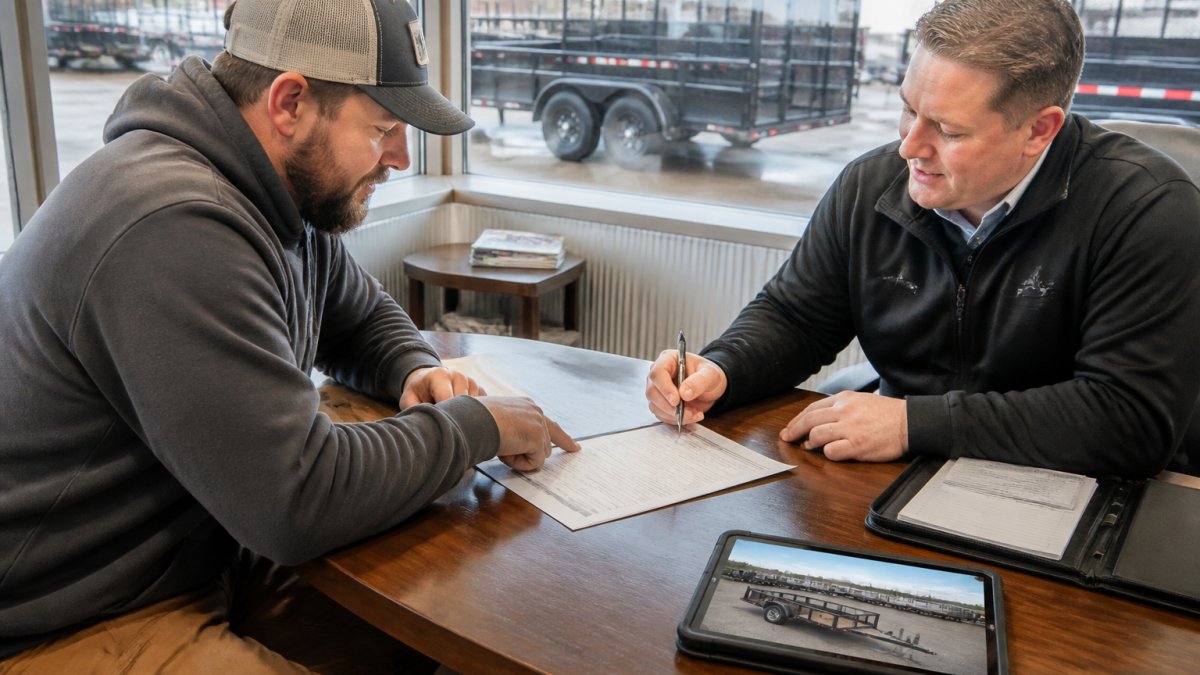
Bring these to your application:
- Government-issued ID and business license
- Two years of tax returns or recent bank statements
- Trailer purchase price and spec sheet
Trailer Financing for Bad Credit: Realistic Paths to Approval
Bad credit does not close the door, but it changes the terms: lenders may require a larger down payment, a higher rate, or a cosigner. No credit check financing options exist at some dealerships, though they typically cost more.
For a deeper walkthrough of the specific programs available, see our guide to trailer financing for bad credit options. If you want a step-by-step process for getting approved with poor credit, our how-to guide for financing trailers with poor credit covers the full sequence.
Trailer Loan Rates and Terms: How to Compare Offers
Comparing trailer loan offers means looking past the monthly payment to the APR, loan term, down payment, and every fee folded into the contract. Two offers with the same payment can differ by thousands of dollars once you account for term length and fees.
| Factor | What to Check | Why It Matters |
|---|---|---|
| Annual percentage rate (APR) | Rate plus origination and documentation fees, expressed as one annualized number | The only apples-to-apples cost measure across lenders |
| Loan term | Months to repay (common equipment terms run 24 to 84 months) | A longer term lowers the payment but raises total interest |
| Down payment | Cash due at signing, often 10% to 20% for business borrowers | Lowers the financed amount and can improve approval odds |
| Origination or documentation fee | Flat fee or percentage of the loan, sometimes $0 to several hundred dollars | A fee rolled into the loan quietly raises the APR |
| Prepayment penalty | Whether early payoff triggers a fee | A penalty can trap you in a high-rate loan |
| Fixed vs. variable rate | Whether the rate can change after signing | A variable rate can raise the payment mid-term |
| Balloon or final payment | Whether a large lump sum is due at the end | A balloon can force refinancing at unknown future rates |
| Insurance and add-ons | Whether coverage, warranties, or protection products are financed | Financed add-ons raise the principal and the interest paid |
A Worked Comparison: Same Trailer, Three Structures
Suppose a commercial utility trailer is priced at $8,000 before tax, title, and license. The table below compares three illustrative structures. The numbers are examples, not quotes, your actual APR, fees, and term depend on the lender and your credit profile.
| Offer A: Short term, low fee | Offer B: Long term, low payment | Offer C: Dealer-arranged with add-ons | |
|---|---|---|---|
| Amount financed | $8,000 | $8,000 | $9,200 (trailer plus $1,200 in financed warranty and protection products) |
| APR | 7.5% | 8.5% | 11.0% |
| Term | 36 months | 60 months | 60 months |
| Monthly payment | About $249 | About $164 | About $200 |
| Total interest | About $958 | About $1,845 | About $2,800 |
| Total paid | About $8,958 | About $9,845 | About $12,000 |
Offer B has the lowest monthly payment but costs roughly $887 more in interest than Offer A because the loan runs two years longer. Offer C has a payment close to Offer A's but costs about $3,000 more in total because financed add-ons raise the principal and the higher APR compounds the difference. The total-paid line is the number to negotiate against.
How Term Length and Rate Interact
Term length and rate pull in opposite directions. A longer term lowers the payment but raises total interest on a depreciating asset; a shorter term costs more per month but usually carries a lower APR. For a trailer you plan to use for years, a middle term, often 36 to 60 months, balances payment size against total cost.
Fees and Add-Ons That Change the Real Cost
Watch for these line items, which can appear on a dealer-arranged contract or an online lender's offer:
- Origination or documentation fee: A flat charge or a percentage of the loan, sometimes rolled into the principal so you pay interest on it.
- Extended warranty or service contract: Priced separately from the trailer and often financed, which means you pay interest on the warranty too.
- Gap coverage or credit insurance: Optional products that may be bundled into the payment without a clear line-item price.
A common pattern is a competitive headline rate while financed add-ons and fees push the effective APR well above it. Compare the financed amount and total of payments, not just the advertised rate.
Questions to Ask Each Lender
- What is the APR, and what fees does it include?
- What is the total of payments if I make every scheduled payment?
- Is the rate fixed or variable, and what index does a variable rate follow?
- Is there a prepayment penalty?
- Are warranties or protection products included in the financed amount, and can I decline them?
- What happens if I pay late, what is the late fee and does it affect the rate?
Compare the answers side by side across every offer, the lowest monthly payment is rarely the cheapest loan.
Should You Finance or Lease a Utility Trailer?
Financing builds ownership and equity; leasing keeps cash free but never ends in ownership. For a commercial utility trailer you will use for years, financing usually wins because you keep the asset and stop paying once the loan is repaid.
Small contractors weighing this decision can browse the best utility trailers for small contractors to match a trailer to their financing plan before committing.
Collateral, Insurance, and Tax Considerations for Business Trailers
Financing a commercial utility trailer is not just a credit decision, it is a secured transaction with title, insurance, and tax consequences that follow you for the life of the loan.
The Trailer as Collateral: Title, Lien, and Release
When a lender finances a trailer, the trailer usually secures the loan: the lender holds a security interest, and in most states its lien is noted on the certificate of title until the loan is paid in full. The practical steps:
- Title application: The dealer or you submit the title application to the state motor vehicle agency, listing the lender as lienholder.
- Lien notation: The state issues a title showing the lender's lien. Some states hold the title electronically until the lien is released.
- Lien release: When the final payment clears, the lender issues a lien release. You then apply for a clean title in your name.
Until the lien is released, you generally cannot sell or transfer the trailer free of the lender's interest without paying off the loan first. Keep the lien release in a safe place; replacing a lost one can take weeks.
Insurance a Lender May Require
A secured lender typically requires physical damage coverage, collision and comprehensive, with the lender named as loss payee, so it is paid first if the trailer is damaged or totaled. Beyond that:
- Commercial auto liability: If the trailer is towed by a business vehicle, the towing vehicle's commercial auto policy often extends liability coverage to the trailer, but confirm the policy's trailer definition and limits.
- General liability: Covers third-party claims arising from your business operations, which may include trailer-related incidents on a job site.
- Cargo coverage: Protects tools and equipment carried in or on the trailer, which a trailer policy alone does not cover.
Ask the lender in writing what coverage and limits it requires, and give your agent the trailer's VIN, purchase price, and lender information before delivery. Buyers often discover at signing that the lender requires a deductible or loss-payee endorsement their existing policy lacks.
Business Credit Versus Personal Credit
- Personal credit: For sole proprietors, newer businesses, and smaller loans, the owner's personal credit score and history often drive the decision. A personal guarantee is common.
- Business credit: An established business with a credit profile, a business credit card, a business loan history, and a D-U-N-S number, may qualify for financing based on business credit alone, sometimes without a personal guarantee.
- Time in business: Many lenders want at least one to two years of operating history for business-credit-based approval.
Check both your personal credit report and business credit profile for errors before applying, and ask each lender which factors it weighs most.
Tax Treatment: Depreciation, Section 179, and Interest
Business-use trailers are generally depreciable business assets, and interest on a loan used to buy business equipment may be deductible. Some buyers may also expense part or all of the trailer's cost in the purchase year under Section 179, subject to annual limits and eligibility rules, or use bonus depreciation where available. Eligibility depends on how the trailer is used, taxable income, and current rules.
Keep these records for your tax preparer: the purchase contract and bill of sale, the financing agreement showing amount financed and APR, the title and registration, insurance declarations, and a log of business versus personal use if the trailer is used for both.
Keeping the Collateral in Good Condition
Because the trailer secures the loan, its condition affects your position. Lenders may require you to maintain it and may prohibit certain modifications. Routine maintenance, tires, lights, brakes, bearings, and the coupler, protects resale value and your ability to satisfy the loan. Our guide to essential trailer parts for regular maintenance covers what to inspect.
Get Preapproved for Your Commercial Utility Trailer at DoubleTake
Prequalification tells you your loan amount and rate before you shop, so you negotiate from strength. At DoubleTake Trailer Sales, we have helped Iowa contractors, farmers, and vendors finance the right trailer since 2010, with in-stock inventory and custom builds to your specs. Our team offers no credit check financing options and flexible solutions for buyers with credit challenges, plus an in-house service and parts department. Compare models in our trailer brand buyer's guide, then get preapproved.
Frequently Asked Questions
Can you finance a utility trailer for business use?
Yes. Lenders treat a commercial utility trailer as business equipment, so you can use an equipment loan, a business loan, or dealer-arranged financing. Business-use trailers often qualify for more flexible terms than personal loans, and interest may be deductible as a business expense. You will typically need a business tax ID, financial statements, and a down payment of 10 to 20 percent to get approved.
What credit score do you need to finance a utility trailer?
Most traditional lenders look for a credit score of at least 650, though some equipment lenders work with scores in the 600s if you have a strong down payment or business history. For bad credit, dealer financing and no-credit-check programs are available, but expect higher rates or larger down payments. Prequalification lets you see your likely terms before a hard inquiry hits your credit.
What documents do you need to apply for commercial trailer financing?
Prepare a government-issued ID, proof of business registration or a tax ID, two years of business tax returns or financial statements, recent bank statements, and a voided check. For a new business, lenders may ask for a personal guarantee, a business plan, and proof of contracts or revenue. Having these ready shortens the approval timeline and improves your negotiating position on rates.
Is it better to finance or lease a commercial utility trailer?
Finance if you plan to keep the trailer long term and want to build equity; you own it outright at the end of the loan. Lease if you need lower monthly payments, want to preserve cash flow, or expect to upgrade equipment every few years. Leasing can also keep the trailer off your balance sheet, which matters if you are managing debt ratios for other business loans.
How can you improve your chances of getting approved for trailer financing?
Make a down payment of at least 20 percent, clean up your credit report before applying, and document steady business revenue. A personal guarantee or collateral can offset a thin business credit file. Applying through a dealer with established lender relationships, like DoubleTake Trailer Sales, often gets better results than applying cold to a national bank, because the dealer can match you to the right program.
The hardest part of financing a commercial utility trailer is not the paperwork, it is knowing which offer actually costs less over the full term. DoubleTake Trailer Sales makes that call easier with flexible financing solutions, custom trailer builds to your specifications, and a service and parts department that stays with you after the sale. Get started with DoubleTake Trailer Sales and finance the trailer that keeps your business moving.