 Ultimate guide
Choosing the Right Trailer for Farm Equipment
Last Updated: October 28, 2026
Quick Summary
Choose a farm equipment trailer by sizing it to your heaviest regular load, not a rare oversized one. Match payload capacity, GVWR, and axle ratings to the load and confirm your tow vehicle's ratings before buying. A utility trailer suits light material, while an equipment trailer handles tractors and machinery.
- List every load you moved in the past twelve months; three or four repeat jobs set your deck length and axle rating.
- Payload capacity equals GVWR minus the trailer's empty weight, so a 7,000 lb GVWR trailer carries roughly 4,500-5,000 lb.
- Weigh your tractor at a certified scale; brochure weights can underestimate by 15-25% once fuel and implements are added.
- Keep 10-15% of loaded trailer weight on the tongue and confirm each axle stays under its rating.
- Verify your state's brake, lighting, and weight thresholds before purchase, since requirements vary by state.
Table of Contents
- Matching a Farm Equipment Trailer to Your Loads and Tasks
- Utility Trailer vs Equipment Trailer: Which Fits Farm Work
- Trailer Payload Capacity, GVWR, and Axle Ratings Explained
- What Size Trailer Do I Need to Haul My Tractor?
- Frame Strength, Deck Length, and Build Quality to Inspect
- Loading and Securing Farm Equipment the Right Way
- Hitch, Towing, and Road Compliance Checks Before You Buy
- Total Cost of Ownership and Maintenance for a Farm Trailer
- Frequently Asked Questions
Matching a Farm Equipment Trailer to Your Loads and Tasks
Choosing the right trailer for farm equipment starts with an honest inventory of what you actually haul, not what you might haul someday. The right farm equipment trailer is the one sized to your heaviest regular load, not your once-a-decade favor for a neighbor.
Start With What You Haul Most Often
Write down every load you moved in the past twelve months. Most operations find three or four repeat jobs dominate: hay bales, a compact tractor, an ATV or side-by-side, fencing materials, and seed or feed.
The occasional oversized load is a rental problem, not a buying problem. A common mistake is buying a trailer that handles the rare load comfortably and the weekly load poorly, which means a heavier, harder-to-tow rig every single day.
Utility Trailer vs Equipment Trailer: Which Fits Farm Work
A utility trailer is a lighter, open-deck trailer built for general-purpose use: tools, ATVs, fencing supplies, and small implements.
The dividing line is weight and loading method, not length. If you're moving mulch, mowers, and material, a utility trailer does the job with less tow vehicle strain.
Trailer Payload Capacity, GVWR, and Axle Ratings Explained
Payload capacity is the maximum weight of cargo a trailer can carry, calculated as gross vehicle weight rating (GVWR) minus the trailer's own weight. GVWR is the total the trailer and its load may weigh together.
A tandem-axle trailer with two 3,500 lb axles does not automatically carry 7,000 lb of cargo. You subtract the trailer's empty weight, and you account for tongue weight transferred to the tow vehicle.
A Practical Load-Calculation Walkthrough
Run this sequence before you shop, using a realistic compact-tractor example:
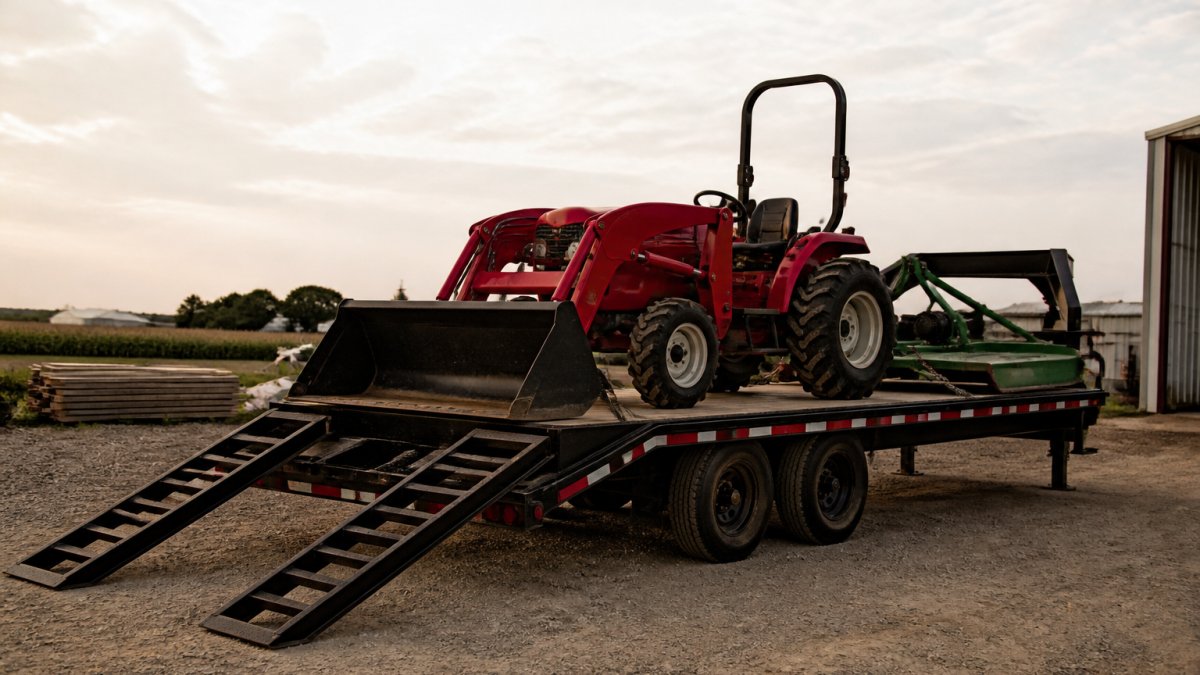
- Weigh the load as it will be hauled. A 35-hp compact tractor with a loader and a box blade commonly lands around 4,000-4,500 lb with fuel and operator. Weigh it at a certified scale rather than trusting the brochure; attachments and loaded tires add hundreds of pounds.
- Add the accessories. Pallet forks, a bale spear, tie-downs, and debris on the deck can add 200-500 lb. Use 4,700 lb as your working loaded weight.
- Compare to payload, not GVWR. If the trailer's empty weight is 2,200 lb and its GVWR is 7,000 lb, payload is 4,800 lb. A 4,700 lb load leaves only 100 lb of margin, too thin for a farm trailer that will see mud, hills, and imperfect loading.
- Check axle loading. With a properly balanced load, roughly 10-15% of the loaded trailer weight should rest on the tongue. On a 6,900 lb loaded trailer, that is about 690-1,035 lb on the hitch and the remainder split across the axles. Confirm each axle stays under its rating after that transfer.
- Confirm the tow vehicle. The hitch rating, receiver, ball mount, and the truck's own payload and towing capacity must all exceed the loaded trailer weight and tongue weight. The trailer's GVWR is not the only ceiling, the truck's ratings are a second, independent limit.
If any step fails, move up a trailer class or down a load. There is no clever workaround, and a trailer that is legal empty can be non-compliant loaded.
Where Buyers Get the Numbers Wrong
Three mistakes show up repeatedly. First, using the manufacturer's dry tractor weight instead of a scale ticket, loaded tires, fuel, and a mounted implement can add 15-25% to the brochure figure. Second, ignoring tongue weight when checking axle capacity, which quietly overloads the rear axle. Third, buying a trailer whose GVWR exceeds the tow vehicle's rated towing capacity, which makes the trailer legal on paper but unsafe and often non-compliant on the road.
These are the numbers to work through before you shop, using the article's compact-tractor example.
| Item | Value | Note |
|---|---|---|
| Tractor with loader and box blade | 4,000-4,500 lb | With fuel and operator; weigh at a certified scale |
| Accessories added | 200-500 lb | Forks, bale spear, tie-downs, debris |
| Working loaded weight | 4,700 lb | Used in the walkthrough |
| Typical 18-foot trailer empty weight | 2,000-2,500 lb | Often in this range |
| Payload on 7,000 lb GVWR trailer | Roughly 4,500-5,000 lb | Not 7,000 lb |
| Tongue weight share | 10-15% of loaded trailer weight | About 690-1,035 lb on a 6,900 lb loaded trailer |
| Brochure weight underestimate | 15-25% | Loaded tires, fuel, mounted implement can add this |
What Size Trailer Do I Need to Haul My Tractor?
Size a trailer to your tractor's length plus attachment overhang, then confirm the deck's payload capacity covers the tractor's weight with margin.
Deck length is the spec buyers regret most. Measure the tractor with its longest attachment mounted, add a foot of clearance front and rear, and buy that length. Trailer dimensions listed as "16-foot" or "18-foot" refer to the flat deck, not the total frame, so verify before you commit.
Frame Strength, Deck Length, and Build Quality to Inspect
Frame strength comes down to frame rails, reinforced crossmembers, and weld quality. Walk the trailer and look at crossmember spacing: tighter spacing means less deck flex under a concentrated load like a tractor tire.
Ask what the frame rails are made of and how the deck is attached. Paint and coating quality tell you how the builder expects the trailer to survive weather and manure. Best Trailer Brands for Contractors covers which brands are worth trusting for durability.
Loading and Securing Farm Equipment the Right Way
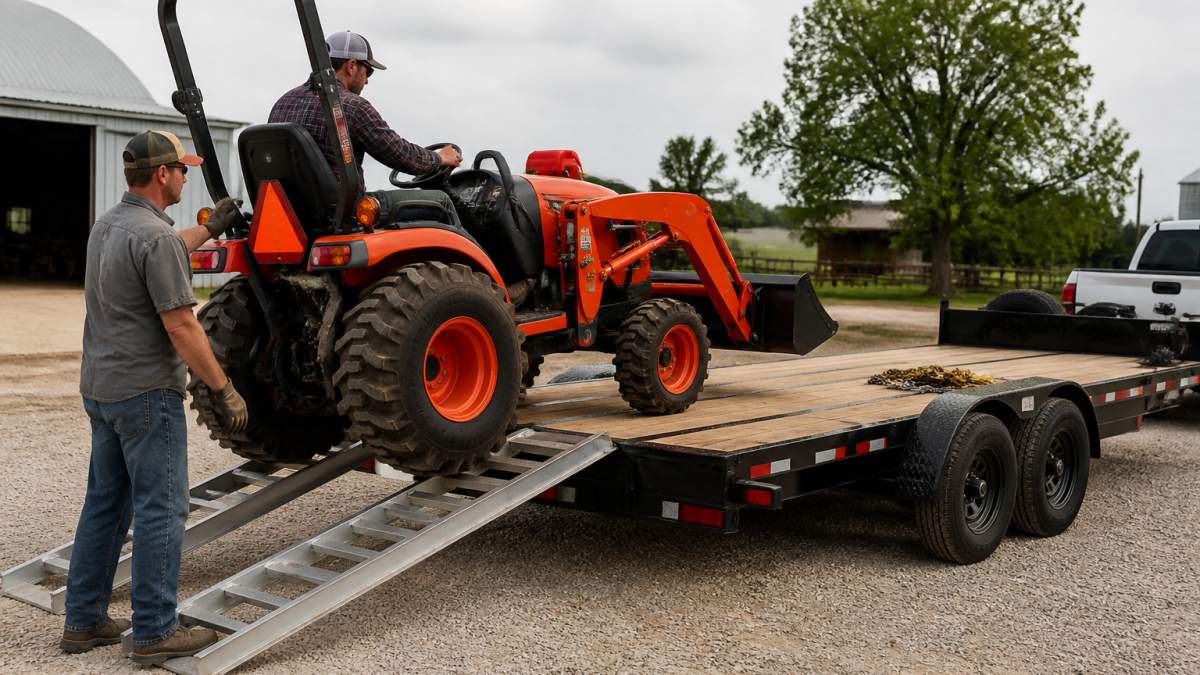
Securing farm equipment means four independent tie-down points, rated chains or straps, and a load balanced so tongue weight stays within your hitch rating. Loading ramps should be rated for the load plus a margin, and the trailer should be hitched to the tow vehicle before anything rolls up the ramps.
Watch out: relying on the parking brake or a single strap on a tractor is how equipment ends up on the highway. Use binders on the frame, not on sheet metal or attachments, and check tension after the first few miles.
Hitch, Towing, and Road Compliance Checks Before You Buy
Road compliance starts with matching the hitch, coupler, and safety chains to your tow vehicle, then confirming lighting and brake requirements for your loaded weight. Most states require trailer brakes above certain weight thresholds, commonly in the 3,000-4,000 lb range for loaded trailers, though the exact figure varies, and requirements differ enough that you should verify your state's rules before purchase rather than assume a neighboring state's threshold applies.
The Federal Baseline
Some equipment rules are set at the federal level and apply regardless of state. The Federal Motor Carrier Safety Administration (FMCSA) regulations in 49 CFR 393.100-393.136 govern cargo securement for commercial motor vehicles, and many states adopt similar language for non-commercial trailers. The practical takeaways for farm hauling:
- Aggregate working load limit. The tiedowns must have an aggregate working load limit of at least 50% of the cargo weight, and the cargo must be immobilized so it cannot shift forward, rearward, or laterally.
- Minimum tiedowns. For cargo over 10,000 lb, at least four tiedowns are required, and they must be attached to the trailer and to the equipment at rated points, not to sheet metal, plastic, or attachments.
- Lighting. Trailers need stop lamps, turn signals, and tail lamps visible from the rear, plus reflectors. Many states also require clearance lamps on wider trailers and side markers on longer ones.
Weight Limits and Licensing
Federal bridge-formula weight limits apply on the Interstate System, and states set their own limits on other roads. For farm trailers, the practical checks are the trailer's GVWR, the tow vehicle's gross combination weight rating (GCWR), and the per-axle ratings. Some states require a special license or endorsement for trailers above a certain weight or length, and farm-use exemptions vary widely, do not assume an agricultural exemption covers a highway trip to a dealer or auction.
A Pre-Purchase Compliance Checklist
- Hitch and ball mount rated for the loaded trailer weight and tongue weight
- Coupler size matches the ball (common sizes are 2 in, 2-5/16 in, and 3 in)
- Safety chains rated and crossed
Compliance is not a one-time purchase decision. Re-check the brake, lighting, and tiedown setup every season, and re-verify your state's thresholds whenever you change tow vehicles or move to a heavier trailer.
Total Cost of Ownership and Maintenance for a Farm Trailer
Total cost of ownership runs beyond the purchase price: tires, bearings, brakes, lights, deck repair, and coating touch-ups add up over a trailer's life. Budget for an annual inspection and grease bearings on schedule; neglected bearings are the most common cause of roadside failure.
A maintenance checklist keeps costs predictable:
- Inspect tires for wear and correct pressure
- Grease wheel bearings per the manufacturer's interval
- Test lights, brake controller, and breakaway system
Frequently Asked Questions
What size trailer do I need to haul my tractor?
Start with the tractor's operating weight from the manual, then add the weight of any loader, ballast, or attachment you leave on. Choose a farm equipment trailer whose payload capacity exceeds that total with margin, and whose deck length clears the tractor plus implement overhang. A 5,000 to 7,000 lb utility trailer suits sub-compact tractors, while 10,000 lb and up equipment trailers fit utility and row-crop tractors. Confirm the loaded tongue weight stays within your hitch rating.
Should I choose a utility trailer or an equipment trailer for farm use?
A utility trailer works for light, low loads such as ATVs, small implements, and fencing supplies, and its lower deck makes hand loading easy. An equipment trailer is intended for heavier machinery. If you regularly haul a tractor or skid steer, consider the load and trailer capacity when choosing a trailer.
How do I calculate the trailer payload capacity I actually need?
Weigh each item you plan to haul, including attachments, fuel, and tools, then add them together. Subtract that total from the trailer's GVWR to see the remaining payload, and keep the result under the axle rating. Remember that payload capacity shrinks once you add a spare tire, toolbox, or other accessories. A simple worksheet listing tractor weight, implement weight, and accessory weight prevents the common mistake of buying a trailer that is already near its limit before loading.
What should I check before buying a farm equipment trailer?
Inspect weld quality at the frame joints and crossmembers, confirm the axle configuration and braking system match the GVWR, and measure deck length against your longest load. Check the hitch rating and towing capacity of your tow vehicle, and confirm the trailer's lighting and tires meet road requirements. Ask about ramp type, tie-down points, and whether the dealer stocks parts. DoubleTake Trailer Sales has an in-house service and parts department.
How do I secure farm equipment on a trailer?
Use four-point tie-down with rated chains or straps, attaching to the equipment's frame rather than sheet metal or lift components. Angle straps forward and back to limit movement, and tighten with binders or ratchets until the suspension compresses slightly. Close the tailgate or gate and check the load after the first few miles. Loading and securing farm equipment properly also means balancing weight over the axles, keeping roughly 10 to 15 percent of the load on the tongue.
Matching a trailer to farm work rewards patience and honest measurement, and it punishes guesswork every harvest. DoubleTake Trailer Sales has helped Iowa farmers and contractors since 2010 find the right fit, with in-stock inventory, custom builds to your specs, flexible financing, and an in-house parts and service department. Get started with DoubleTake Trailer Sales and haul your next load with confidence.