 Ultimate guide
Mobile Food Trailer Permits for Beginners: 2026 Guide
Last Updated: November 21, 2026
Quick Summary
Mobile food trailer permits for beginners should be secured in a specific order: call your state health department first to confirm your mobile food unit classification, then contact the county or city for the permit application packet, and review equipment requirements before buying a trailer. Getting this order wrong is the most expensive mistake new vendors make.
- The FDA Food Code sets the baseline sanitation standards most states adopt, so read it early.
- Most states issue the sales tax permit at no charge, but you must register before collecting tax.
- Most jurisdictions require a handwashing sink with hot and cold water and a wastewater tank larger than the fresh tank.
- Fire inspection scheduling is one of the most common reasons opening day slips, so book it early.
- Health permits are jurisdiction-specific, so a permit from one county generally does not authorize operation in another.
Table of Contents
- The Beginner's Permit Sequence: What to Do Before You Buy a Trailer
- Food Trailer License and Permits: Every Document You Need
- Food Trailer Health Department Requirements and Commissary Rules
- Fire Inspection and Business Registration Steps
- Food Trailer Permit Cost: Building a Realistic Budget
- Your Food Trailer Inspection Checklist Before Opening Day
- Frequently Asked Questions
The Beginner's Permit Sequence: What to Do Before You Buy a Trailer
Mobile food trailer permits for beginners follow a specific order, and getting that order wrong is the most expensive mistake new vendors make when securing mobile food trailer permits. Before you hand over money for a trailer, confirm which permits your state and county require, because equipment specs are written into those rules and they dictate what you can legally buy.
Too many first-time vendors buy a trailer and then discover the handwashing sink is the wrong size or the ventilation hood doesn't meet code. The sequence that saves money looks like this:
- Call your state health department and confirm the mobile food unit classification
- Contact the county or city where you plan to operate and ask for the permit application packet
- Review equipment requirements before shopping for a trailer
- Secure a commissary agreement if your state requires one
- Apply for permits, then buy or build the trailer to match the approved plan
The FDA Food Code sets the baseline sanitation standards most states adopt, so reading it early tells you what inspectors expect. Skipping this step means buying twice.
Which Agency to Contact First (and What Depends on What)
The order above is not arbitrary, each approval unlocks the next, and a few of them run in parallel. Here is the dependency chain most beginners never see laid out:
- State health department first. This call determines your unit classification (mobile food unit, mobile food establishment, pushcart, or temporary food establishment). That classification sets your equipment requirements, so it has to come before any trailer shopping. Ask for the current mobile food unit regulations in writing.
- County or city health department second. In many states the county administers the permit even though the state writes the rule. Ask which code version they enforce and request the application packet and equipment checklist.
- Commissary agreement third, if required. Some states require a licensed commissary or base of operations for cleaning, restocking, and wastewater disposal. Without it, the health permit application is incomplete.
The Pre-Purchase Decision Tree
Before you buy, answer these questions in order. A "no" at any step means stop and resolve it before spending money on a trailer:
- Do I know my unit classification? If not, call the state health department. Everything downstream depends on this answer.
- Do I have the county's current equipment checklist? If not, request it. Build your trailer spec from that document, not from a dealer photo.
- Does my state require a commissary? If yes, secure a signed agreement before applying.
- Will my menu require a ventilation hood? If you plan to cook with grease or open flame, confirm hood and fire-suppression requirements with the fire marshal before ordering a build.
- Does the trailer I'm considering match the checklist line by line? If not, walk away or budget for a rebuild.
Watch out: buying a used trailer before confirming the current equipment checklist can force a rebuild.
Food Trailer License and Permits: Every Document You Need
A food trailer license and permits typically include a mobile food unit permit from the health department, a business license, a sales tax permit, a fire inspection sign-off, and a commissary agreement where required. Most beginners need several separate documents before opening day.
Here's the documentation checklist we walk new vendors through:
- Health department mobile food unit permit application
- Menu and food preparation plan
- Trailer floor plan and equipment spec sheet
What Each Document Actually Requires
A checklist is only useful if you know what goes inside each line item. Here is what most agencies expect:
- Mobile food unit permit application. The form itself, plus the fee, plus the supporting documents below. Incomplete packets are the most common cause of delay.
- Menu and food preparation plan. List every item you will sell and how it is prepared, held, and served. If you plan to cook raw proteins, say so, it changes your equipment and commissary requirements.
- Trailer floor plan and equipment spec sheet. A dimensioned drawing showing sink locations, tank capacities, refrigeration, ventilation, and power. The drawing must match the trailer you actually buy.
Realistic Timeline From First Call to Opening Day
Most beginners underestimate how long approvals take because the steps are sequential. A common pattern looks like this:
- Weeks 1-2: State health department call, county packet request, and commissary search.
- Weeks 2-4: Business registration, EIN, sales tax permit, and insurance quotes. These run in parallel with health paperwork.
- Weeks 3-6: Trailer purchase or build. Custom builds can take considerably longer than in-stock units, so confirm lead time before you commit.
Timelines vary widely by jurisdiction, so ask each agency for its current review window in writing rather than assuming.
Which Approvals Transfer (and Which Do Not)
This is the part almost no beginner guide covers, and it is where vendors get burned when they expand. As a general rule:
- Health permits are jurisdiction-specific. A permit issued by one county generally does not authorize operation in another. If you plan to work multiple counties, ask each one whether it accepts the others' inspections or requires its own.
- Fire approvals are typically local. A fire marshal's sign-off in one jurisdiction may not be accepted next door.
- Business licenses are local. A city license does not cover a neighboring city.
Watch out: assuming a permit travels with the trailer can cause problems in multi-jurisdiction operation, confirm transfer rules with each agency before you commit to a new territory.
Food Trailer Health Department Requirements and Commissary Rules
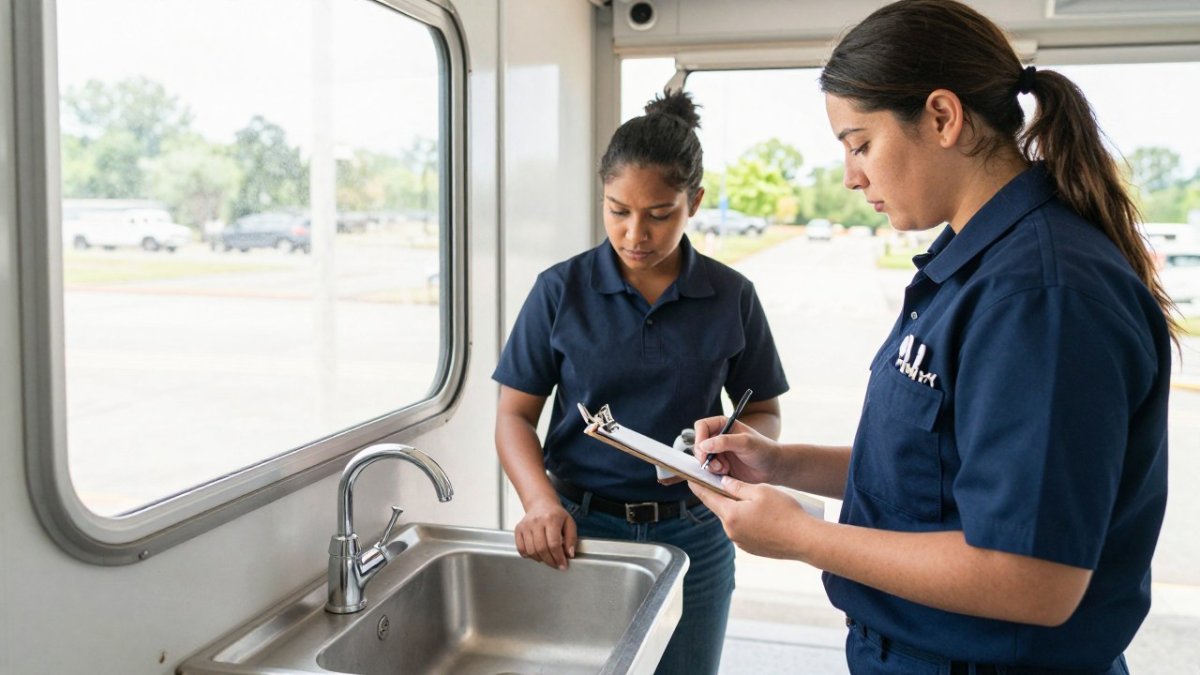
Food trailer health department requirements center on potable water, wastewater capacity, handwashing, refrigeration, and a commissary for cleaning and restocking. Inspectors verify each one physically, so the equipment has to be installed, not promised.
Water, Wastewater, and Handwashing Sink Specs
Most jurisdictions require a dedicated handwashing sink with hot and cold running water, a fresh water tank sized to your operating day, and a wastewater tank larger than the fresh tank. Common beginner mistakes here include plumbing the handwash sink into the three-compartment sink line or installing a tank that's too small for a full shift.
Fire Inspection and Business Registration Steps
Fire inspection and business registration run in parallel, and both must be complete before the health department will schedule your final review.
Fire inspectors check for a fire extinguisher with a current tag, a ventilation hood over cooking equipment, and proper clearance around heat sources. Book the fire inspection early, because scheduling delays are one of the most common reasons opening day slips.
Food Trailer Permit Cost: Building a Realistic Budget
Food trailer permit cost varies by state, county, and unit type, so request the current fee schedule from each agency directly. Request the current fee schedule from each agency directly and build your budget from those documents.
Budget for these line items:
| Cost Category | What to Confirm | Recurring? |
|---|---|---|
| Health permit fee | Fee schedule from county health department | Annual |
| Business license | City or county clerk fee | Annual |
| Sales tax permit | State revenue department | No fee typically |
| Fire inspection | Local fire marshal fee | Annual |
| Commissary fees | Monthly base-of-operations charge | Monthly |
| Insurance | Vendor policy premium | Annual |
| Trailer purchase | Dealer quote | One-time |
If the total strains your cash flow, financing options for trailers can spread the trailer cost while you cover permit fees outright.
Your Food Trailer Inspection Checklist Before Opening Day
Food trailer inspection checklist items fall into three groups: paperwork, equipment, and cleanliness. Have every document in a binder and every surface spotless when the inspector arrives, because first impressions shape how closely they look at everything else.
Permits take time, and the trailer has to be ready when they clear. DoubleTake Trailer Sales builds concession trailers to your specifications, offers flexible financing, and supports every unit with an in-house service and parts department.
Frequently Asked Questions
What permits do I need to operate a mobile food trailer?
Most beginners need four core approvals: a state or county mobile food unit permit from the health department, a local business license, a fire inspection sign-off, and a commissary agreement if your jurisdiction requires one. Some cities add a peddler's or mobile vendor license, and you may need a separate permit for each county you sell in. Build an application packet that includes your menu, trailer floor plan, equipment list, and commissary paperwork, then submit to each agency in the order they require.
How much does it cost to get permits for a food trailer?
Food trailer permit cost varies widely by state and county, so ask your local health department for its current fee schedule before you commit to a trailer purchase. Budget for the mobile food unit permit, business license, fire inspection, commissary fees, and annual renewals as separate line items. Plan-review fees and plan resubmissions can add to the total. Keep every receipt, since some jurisdictions charge again if you change your menu or add equipment after approval.
How long does it take to get a mobile food trailer permit?
Timelines depend on your health department's review queue and how complete your application packet is. Plan-review backlogs can add weeks, and an incomplete packet restarts the clock. Submit your menu, equipment specs, and commissary agreement together, and schedule the fire inspection early since it often runs on a separate calendar. Apply before your trailer is finished so the plan review and build happen at the same time rather than back to back.
Does a mobile food trailer need a commissary kitchen?
Many jurisdictions require a commissary agreement, which is a written arrangement with a licensed kitchen where you prep food, wash large equipment, and dispose of wastewater. Rules differ by state and county, so confirm the requirement before you sign a lease or buy a trailer. Some areas allow a fully self-contained unit to skip the commissary, but you usually need to prove adequate water, wastewater, and refrigeration capacity. Keep the signed agreement in your application packet.
What inspections does a food trailer need before opening?
Expect at least two: a health department inspection covering food safety, sanitation, handwashing, water supply, and refrigeration temperatures, and a fire inspection covering extinguishers, ventilation, and fuel systems. Some areas combine them, others require separate appointments. Use a food trailer inspection checklist and walk the unit yourself first, checking that all equipment matches the approved plan. Anything added after plan approval can trigger a re-inspection fee.
Can I operate a food trailer in more than one state?
Rarely with a single permit. Mobile food trailer permits are issued by state and county agencies, and each one sets its own rules on commissary access, labeling, and inspections. Selling across state lines usually means applying in each state and often each county, plus meeting the strictest standard among them. If multi-jurisdiction operation is your plan, choose equipment that meets the toughest likely requirement and keep a complete document file you can submit anywhere.
Do I need an LLC to run a food trailer?
Most states do not require an LLC to get a mobile food unit permit, but forming one separates your personal assets from business liabilities and simplifies insurance and taxes. Register your business name, get an EIN, and check whether your city requires a general business license regardless of entity type. Ask your insurer whether an LLC affects your coverage. The registration step is quick, and doing it before you apply keeps your permit paperwork consistent.