 blog
blog
Best Trailer Brands for Contractors: 2026 Buyer's Guide
Table of Contents
- What Separates a Pro-Grade Contractor Trailer From a Consumer Model
- An Enclosed Trailer Buying Guide for Contractors: Size, Doors, and Layout
- Aluminum vs. Steel: Material Durability and Curb Weight Trade-Offs
- Contractor Trailer Weight Distribution Tips for Safer Towing
- Financing Options for Commercial Trailers: What Lenders Actually Look At
- Custom Trailer Builds for Contractors: Timeline, Specs, and What to Ask
- Total Cost of Ownership: Maintenance, DOT Compliance, and Resale Value
- Conclusion: How to Choose Among the Best Trailer Brands for Contractors
- Frequently Asked Questions
Last Updated: September 23, 2026
What Separates a Pro-Grade Contractor Trailer From a Consumer Model
The best trailer brands for contractors build to commercial standards, not weekend-hauler standards. That shows up in frame thickness, axle rating, and the GVWR stamped on the tongue, a commercial-grade trailer is engineered to run loaded, every day, for years.
Frame Construction, Axle Rating, and GVWR Explained
GVWR is the maximum total weight a trailer can carry, including its own weight. Payload capacity is GVWR minus curb weight, the number that matters when loading tools and materials.
Three specs decide whether a trailer is commercial grade:
- Frame construction: Look for a full steel chassis with crossmembers spaced close together. Thin-walled tubing and spot welds are consumer-grade shortcuts.
- Axle rating: Each axle carries a rated capacity. Undersized axles flex under load and eat tires.
- Tongue weight: Typically 10-15% of total loaded weight. Get this wrong and the trailer sways at highway speed.
Tandem Axle vs. Single Axle: Which Setup Handles Job Site Loads
Tandem axle wins for almost every contractor application: two axles spread the load, track straighter, and handle a blowout far better at highway speed. Single axles make sense only for light utility work under roughly 3,000 pounds. Torsion rides smoother; leaf spring is easier to service on the road.
An Enclosed Trailer Buying Guide for Contractors: Size, Doors, and Layout
An enclosed trailer buying guide for contractors starts with three questions: what you haul, how you load it, and where you park it. The fourth, interior organization, is the one most buyers answer too late.
Sizing by Trade: What Actually Fits
Common sizing for trades:
- 6x12: Small crews, hand tools, light materials. Works for a solo electrician or handyman running service calls.
- 7x14 to 7x16: The most common single-trade size. Fits a plumber's or HVAC tech's parts inventory, pipe racks, and a small workbench.
- 8.5x20: Full crews, ladder racks, interior shelving. The default for general contractors hauling material plus tools.
- 8.5x24+: Equipment plus material, often with a walk-on roof. Common for excavation support, landscaping, and remodel crews.
Width matters more than length for layout: an 8.5-foot-wide trailer allows shelving on both walls plus a center aisle, while a 7-foot-wide forces you to choose one wall for storage.
Barn Doors vs. Ramp Door and Walk-On Roof Options
Barn doors give full-height access and work well when you park against a wall; a ramp door is faster for rolling equipment. Many contractors spec one of each, barn doors on the rear for material, a side ramp or door for daily tool access. A walk-on roof lets you load ladders and long material from above; if you carry 28-foot extension ladders or conduit, spec it with a ladder rack rated for the load.
Interior Organization by Trade: The Spec Sheet Most Buyers Skip
This is where a contractor trailer stops being a box and starts being a mobile workshop. Choose an organization system that matches how you actually work, not how a catalog photo looks.
Plumbing and HVAC:
- Pipe racks sized for 10-foot and 20-foot stock
- Heavy-duty shelving for fittings, valves, and parts bins
- A workbench with a vise for cutting and threading on site
- E-track at multiple heights for reconfiguring as jobs change
Electrical:
- Wire spool racks mounted high, feeding down through a guide
- Bin shelving for breakers, boxes, and devices
- A dedicated conduit rack for 10-foot sticks
- Lockable cabinet for test equipment and meters
Carpentry and general contracting:
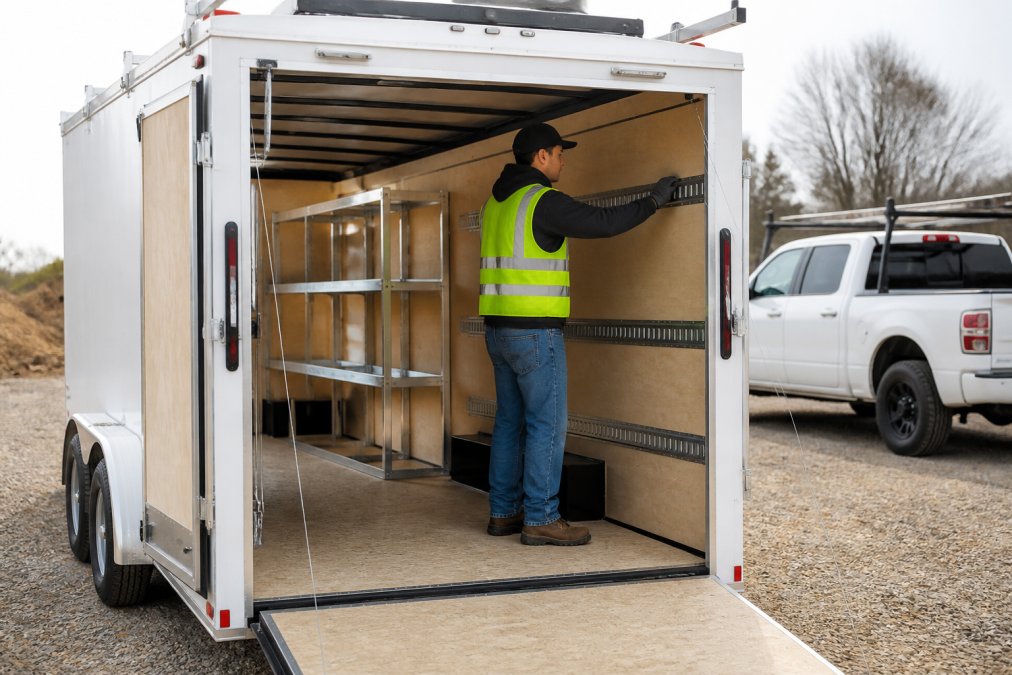
- Full-length E-track on both walls for adjustable shelving
- A fold-down workbench that stows when you need the floor
- Miter saw stand mount with a dedicated power drop
- Material racks for trim, sheet goods, and framing lumber
Landscaping and site work:
- Open floor space prioritized over shelving
- E-track and D-rings for equipment tie-down
- Fuel and oil storage in a ventilated, lockable cabinet
- Ramp door rated for your heaviest walk-behind or mower
The Hardware That Makes It Work
- E-track, horizontal rails at two or three heights on both walls. Accepts clip-in shelving, D-rings, and straps; the most flexible system for changing loads.
- D-rings, bolted through the floor or frame for heavy tie-down points. Space them every 24-36 inches along the walls and at the corners.
- Shelving, fixed or adjustable; E-track shelving lets you change the layout when inventory changes.
- Workbench, fold-down or fixed; a fold-down bench preserves floor space for loading equipment.
- LED lighting, interior strip lights on a switch, plus exterior work lights aimed at the side and rear.
- Power, a 12V system tied to the tow vehicle, or a small inverter for charging tools. Spec the wiring before the walls go up.
Layout Rules That Save Time on the Job
- Load heavy items over the axles. Keeps tongue weight in range and the trailer tracking straight.
- Keep a clear center aisle. If you can't walk from the rear door to the front wall with your hands full, the layout is wrong.
- Put daily-use tools near the door. Saws, drills, and meters should come out first without unloading.
- Reserve one wall for long stock. Pipe, conduit, and trim need a dedicated rack, not a corner where they roll around.
- Plan the power drops before the walls close. Outlets and lights are cheap at build time and expensive later.
A trailer spec'd around your trade's workflow will outwork a generic unit every day. Size and doors get you in the door; interior organization makes the trailer a tool instead of a storage box.
Aluminum vs. Steel: Material Durability and Curb Weight Trade-Offs
Aluminum frame trailers save weight, more payload for the same GVWR, resist rust, and hold resale value well. The trade-off is cost and, sometimes, repairability after a hard hit. Steel chassis trailers cost less up front and take a beating, but they're heavier and need more rust prevention in humid climates. For most contractors, a steel chassis with an aluminum skin is the practical middle ground.
Contractor Trailer Weight Distribution Tips for Safer Towing
Contractor trailer weight distribution tips come down to one rule: load heavy items over the axles and keep tongue weight in the 10-15% range. Too little and the trailer sways; too much and you overload the tow vehicle's rear axle.
Practical steps:
- Put the heaviest tools directly over or just ahead of the axles
- Secure everything with E-track and D-rings, not just straps over the top
- Weigh the loaded trailer at a public scale before your first long haul
- Match your towing vehicle's rated towing capacity to the loaded weight, not the empty weight
Financing Options for Commercial Trailers: What Lenders Actually Look At
Financing options for commercial trailers hinge on three things: your business history, the trailer's use, and your credit profile. Lenders want to see the trailer produces revenue, not just sits in a driveway.
What underwriters look at:
- Time in business and revenue consistency
- Whether the trailer is titled to a business or an individual
- Down payment size
- Collateral value and resale market for that trailer type
Custom Trailer Builds for Contractors: Timeline, Specs, and What to Ask
Custom trailer builds for contractors usually run several weeks from order to delivery, depending on the shop's backlog and how unusual your specs are. Plan around that window rather than assuming off-the-lot availability.
Specs to lock down before you order:
- Exact interior dimensions and door placement
- Axle rating and suspension type
- Interior organization: shelving, E-track, D-rings, LED lighting
- Exterior: ladder rack, diamond plate trim, weatherproofing
- Electrical: interior lights, exterior work lights, charging for tools
Total Cost of Ownership: Maintenance, DOT Compliance, and Resale Value
Purchase price is the smallest number in the real cost of a contractor trailer. The bigger numbers are what you spend keeping it legal, insured, and roadworthy, and what you recover when you sell it.
The Five Cost Buckets That Actually Matter
| Cost Category | What Drives It | Typical Annual Range | How to Control It |
|---|---|---|---|
| Preventative maintenance | Bearings, brakes, tires, seals | $150-$400 | Service on a set schedule, not when something breaks |
| Tires | Load range, mileage, sun exposure | $200-$600 (amortized) | Rotate, cover when parked, replace in matched pairs |
| Insurance | Declared value, use class, tow vehicle | $300-$900 | Shop coverage annually; bundle with commercial auto |
| DOT compliance | Lighting, brakes, markings, registration | $50-$250 | Inspect before every long haul; keep paperwork in the cab |
| Depreciation | Brand, condition, service records | 8-15% of purchase price per year | Buy a brand with a documented resale market |
These are planning ranges, not quotes; your numbers depend on trailer size, mileage, and storage. The pattern most contractors miss: maintenance and tires together usually cost more per year than insurance, yet insurance is the line item they shop hardest.
DOT Compliance: What Applies to a Contractor Trailer
A trailer used in a business is not the same as a trailer used for personal hauling. Once you cross certain weight and use thresholds, federal and state rules kick in. The framework comes from FMCSA vehicle weight and safety guidance, and the practical items to keep current are:
- Registration and plates, commercial plates in most states once the trailer is used for business
- Lighting and reflectors, working brake lights, turn signals, clearance lights, and reflective tape on the sides and rear
- Brakes, electric or surge brakes on at least one axle once you're past a few thousand pounds loaded
- Safety chains and breakaway system, required on virtually every commercial trailer
- Tire condition and load rating, matched to the trailer's GVWR, not just what fits the rim
Depreciation and Resale: What Holds Value
Trailers used for business may be depreciable under IRS guidance on business vehicle and equipment depreciation, which changes the true cost of ownership. But the bigger lever is resale. A common pattern among contractors who track this:
- Enclosed trailers from established brands tend to hold value best, especially in the 7x14 to 8.5x20 range, the sizes with the widest buyer pool
- Aluminum frames typically resell faster than steel in coastal and humid markets because buyers pay a premium for rust resistance
- Documented service records, bearing greases, brake jobs, tire dates, can move the sale price meaningfully versus a trailer with no history
- Custom interiors help or hurt depending on the trade. E-track and shelving appeal broadly; a built-in workbench sized for one specific truck may narrow your buyer pool
The Maintenance Schedule That Protects Resale
Preventative maintenance is the single biggest lever on both reliability and resale. A workable schedule for regular contractor use:
- Before every haul: lights, tires, coupler, safety chains, breakaway cable
- Every 3,000-5,000 miles or twice a year: repack or grease wheel bearings, inspect brake shoes and drums
- Annually: check frame for rust or cracks, reseal roof and seams, test breakaway battery, review insurance declared value
- Every 5-7 years: expect to replace tires regardless of tread, and budget for brake hardware
Insurance: What Underwriters Want to See
Commercial trailer coverage is usually written alongside your commercial auto policy. Underwriters care about declared value, how the trailer is used (hauling your own tools vs. hauling for hire), where it's stored overnight, and your loss history. A trailer stored in a locked yard or garage typically prices better than one parked on the street.
Conclusion: How to Choose Among the Best Trailer Brands for Contractors
Choosing among the best trailer brands for contractors comes down to matching build quality to your actual workload, then buying from a dealer who'll still be there for parts and service in year five.
Frequently Asked Questions
What is the best size trailer for a contractor?
Most general contractors land on a 16 to 20 foot enclosed trailer with a 7,000 lb GVWR, which fits mowers, compressors, and material without exceeding half-ton truck towing limits. Trades hauling skid steers or mini excavators usually step up to a 14,000 lb tandem axle dump or deckover. Match the trailer's GVWR to your tow vehicle's rating first, then size the box around your largest piece of equipment plus at least 2 feet of working space.
Are aluminum or steel trailers better for daily job site use?
Aluminum frames cut curb weight by roughly 30% versus steel, which raises payload capacity on the same tow vehicle and resists rust in salt and snow. Steel chassis cost less upfront and tolerate rougher abuse, but they need more touch-up work on paint and welds. For contractors running daily routes, aluminum usually pays back through higher payload and stronger resale; steel makes sense for heavy dump applications where weight is less of a constraint.
How does the 60/40 weight distribution rule apply to contractor trailers?
The 60/40 rule says about 60% of cargo weight should sit ahead of the trailer axles and 40% behind, so tongue weight lands between 10% and 15% of total loaded weight. Load heavy tools like compressors and generators over the axles or slightly forward, and keep lighter items at the rear. Check tongue weight with a scale before long hauls, and confirm your hitch and ball rating covers it.
What should I expect from financing options for commercial trailers?
Lenders look at time in business, monthly revenue, and whether the trailer is titled to a company or an individual. Some dealerships offer no credit check financing with larger down payments, while traditional equipment loans require two years of tax returns and run 36 to 60 month terms. Ask about prepayment penalties and whether the loan reports to business credit bureaus, since on-time trailer payments can help you qualify for larger equipment later.