 how-to
Trailer Financing for Bad Credit Options in 2026
Table of Contents
- How Trailer Financing for Bad Credit Options Compare
- Rent-to-Own Trailer No Credit Check: How It Works and What It Costs
- Trailer Loan Requirements: What Lenders Actually Look For
- Trailer Financing Down Payment: What to Expect with Bad Credit
- Total Cost of Ownership: Rent-to-Own vs. Subprime Financing
- Early Payoff Penalties and Credit Repair Impact
- Matching Trailer Type to Your Financing Options
- Frequently Asked Questions
Last Updated: September 28, 2026
How Trailer Financing for Bad Credit Options Compare
Trailer financing for bad credit options comes down to three main paths: traditional bank loans, rent-to-own agreements, and dealer-arranged financing. Each one treats a weak credit profile differently, and the gap between them is wider than most buyers expect.
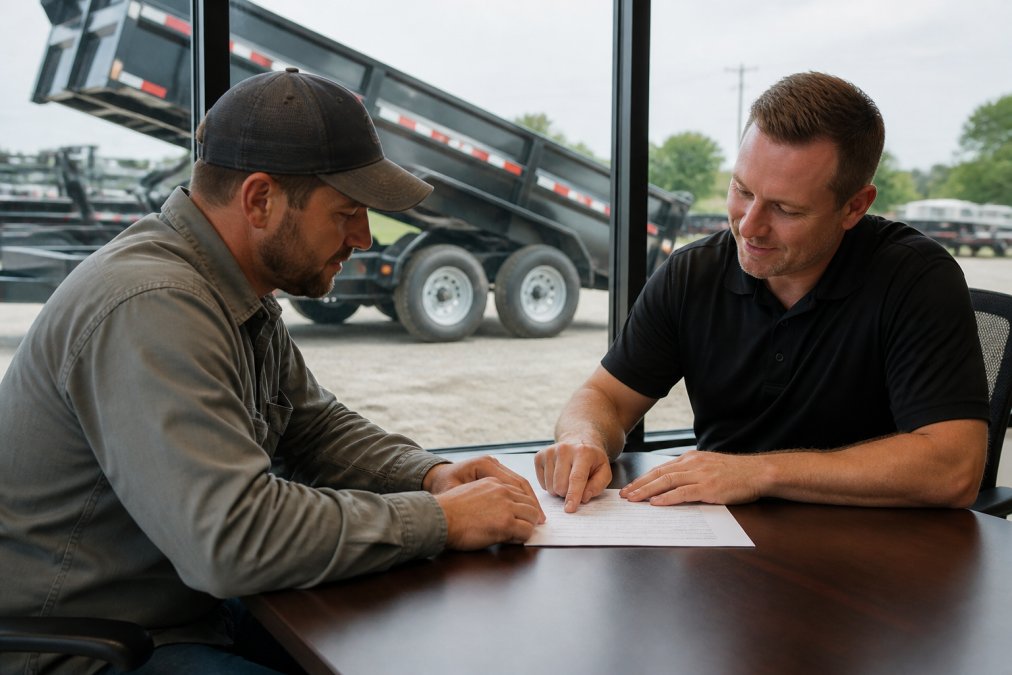
At DoubleTake Trailer Sales, we talk with contractors, farmers, and small business owners every week who assume bad credit closes the door on ownership. It rarely does. It just changes which door you walk through.
A common mistake is treating all three options as interchangeable. They are not.
| Option | Credit Check | Typical Approval Speed | Ownership | Best For |
|---|---|---|---|---|
| Traditional bank loan | Hard pull, strict score minimum | Days to weeks | Immediate | Strong credit, lowest rates |
| Rent-to-own | Often no credit check | Same day | After final payment | Very poor or no credit |
| Dealer financing | Soft credit pull common | Same day to 48 hours | Immediate | Subprime buyers who want to own now |
Traditional Bank Loans vs. Rent-to-Own vs. Dealer Financing
Banks want collateral, a clean credit history, and a debt-to-income ratio that proves you can carry the payment. If your credit score sits in subprime territory, most banks will decline before the conversation starts.
Rent-to-Own Trailer No Credit Check: How It Works and What It Costs
Rent-to-own trailer no credit check programs let you take a trailer home with little or no money down and no credit history review. You pay weekly or monthly, and the trailer becomes yours once the full agreement is paid. That headline is accurate, but it hides the part that matters: how the contract is structured and what it actually costs across the full term.
How the Cost Actually Stacks Up
A typical rent-to-own structure works like this: the dealer sets a cash price for the trailer, then multiplies it across a payment term that can run two to three times longer than a comparable installment loan. The effective cost of credit on that spread is often several times what a subprime installment loan would charge, even after accounting for the higher rate a weak credit profile earns.
Three mechanisms drive the gap:
- Term length. A trailer that would finance over 36 to 60 months on an installment loan may be leased over 24 to 36 months of weekly payments, which compresses the schedule but inflates the total.
- Built-in fees. Processing, liability, and "optional" add-ons like damage waivers are frequently folded into the payment rather than quoted separately.
- Reinstatement clauses. Miss a payment and many agreements require you to pay a reinstatement fee plus the missed amount to keep the contract alive. Miss enough and the trailer is repossessed with no equity returned.
Questions to Ask Before You Sign
Ask these five questions and get the answers in writing:
- What is the total cost if I pay the full term, and how does it compare to the cash price?
- Is there an early payoff penalty, and how is it calculated?
- What happens if I miss a payment, is there a reinstatement fee, and how many misses trigger repossession?
- Do my payments report to the credit bureaus, or am I building no credit history while I pay?
- Who handles service and parts if something breaks, and is that covered in the agreement?
Trailer Loan Requirements: What Lenders Actually Look For
Trailer loan requirements vary by lender, but most weigh four things: credit score, debt-to-income ratio, down payment, and documentation. A secured loan backed by the trailer itself is easier to get than an unsecured one.
Documents You Will Need
Most lenders ask for the same short list:
- Government-issued photo ID
- Proof of income, such as recent pay stubs or tax returns
- Bank statements from the last two to three months
- A utility bill or lease showing your address
- Business license or farm registration, if the trailer is for work
Having these ready before you apply speeds up the approval process and can improve your terms.
Credit Score and Debt-to-Income Thresholds
Prime lenders usually want a credit score well above subprime range and a debt-to-income ratio under roughly 43 percent. Subprime lenders accept lower scores but charge higher interest rates to offset default risk.
Trailer Financing Down Payment: What to Expect with Bad Credit
Trailer financing down payment amounts climb as credit quality drops. A buyer with strong credit might put down a small percentage, while a subprime buyer may be asked for a fifth to a third of the purchase price.
Total Cost of Ownership: Rent-to-Own vs. Subprime Financing
Total cost of ownership is where rent-to-own loses ground fast. Two buyers can walk away with the same trailer and pay wildly different amounts depending on the structure of the deal.
Run the math before you commit:
- Add up every payment across the full term for each option
- Add any fees, penalties, or processing charges
- Compare the totals, not the monthly payment
Early Payoff Penalties and Credit Repair Impact
Early payoff penalties are the hidden cost most buyers miss. A penalty charges you a fee for paying the loan off ahead of schedule, which protects the lender's expected interest income. Not every loan has one. Ask directly, and get the answer in writing before you sign. If a lender will not put it in writing, treat that as a warning sign.
How Early Payoff Penalties Are Calculated
Penalties come in a few common shapes, and knowing which one you are looking at tells you how much paying ahead will actually cost:
- Flat fee. A set dollar amount, regardless of how much interest the lender loses. Easiest to plan around.
- Percentage of remaining balance. Usually a small single-digit percentage of what you still owe. The earlier you pay off, the more it costs.
- Rule of 78s / sum-of-the-digits. Interest is front-loaded, so paying off early saves you far less than the schedule suggests. This structure is restricted for some consumer loans but still appears in certain commercial and lease agreements.
- Prepayment penalty period. A window, often the first 12 to 24 months, during which any payoff triggers a fee. After the window closes, you can pay freely.
How a Trailer Loan Can Rebuild Your Credit
This is the part most financing pages skip. A trailer loan is not just a way to get equipment, structured correctly, it is a credit-building tool. Here is the roadmap:
- Confirm the lender reports to the bureaus. Ask which of the three major credit bureaus the account will be reported to. If the answer is none, the loan will not help your score no matter how reliably you pay.
- Make every payment on time. Payment history is the single largest factor in most credit scoring models. One 30-day late mark can set a score back meaningfully; a clean 12-month history on an installment account does the opposite.
- Keep the balance moving down. Credit utilization matters on revolving accounts, but on installment loans the scoring models also reward steady principal reduction over the term.
- Do not close the account early if it is your only installment tradeline. A mix of account types helps scores. If the trailer loan is your only installment account, paying it off removes that mix from your file.
- Watch for a score dip at origination. A new hard inquiry and a new account can shave points in the first month or two. The recovery comes as the on-time history accumulates.
Matching Trailer Type to Your Financing Options
Trailer type should shape your financing choice, not the other way around. A dump trailer used daily for job site debris is a work asset that justifies dealer financing. A concession trailer for a mobile food vendor may fit either path depending on your cash flow.
Match the option to the use:
- Dump and utility trailers: dealer financing or bank loan, since these are revenue tools
- Enclosed trailers for contractors: dealer financing with a secured loan
- Concession trailers: weigh rent-to-own against subprime financing based on seasonality
- Car haulers and specialty builds: custom orders often pair best with dealer-arranged financing
Frequently Asked Questions
What credit score is needed for a trailer?
Most lenders look for a score of 600 or higher for traditional trailer financing, but subprime programs and rent-to-own options work with scores below 600. Some dealerships offer no credit check financing, though these come with higher rates or fees. A soft credit pull can give you a pre-approval estimate without hurting your score, so you can see where you stand before committing.
How does rent-to-own trailer no credit check financing work?
With rent-to-own, you make fixed monthly payments to use the trailer while the dealer retains ownership. After a set term, ownership transfers to you. No credit check is required, but the total cost is usually higher than a secured loan. Read the agreement carefully for early payoff penalties and default terms, since missing a payment can void the ownership transfer.
Does a trailer loan require a down payment if I have bad credit?
Most subprime trailer loans require a down payment, often between 10% and 20% of the trailer price. A larger down payment lowers your monthly payment and reduces the lender's risk, which can improve your approval odds. Some rent-to-own agreements skip the down payment but charge higher monthly fees instead. Ask the dealer for a written breakdown before signing.
What are the alternatives to traditional bank loans for trailers?
Beyond banks, you can try dealership financing, credit unions, online subprime lenders, or equipment financing companies. Some dealers offer in-house installment plans with soft credit pulls. A co-signer with good credit can also help you qualify for better rates. Each option varies in trailer loan requirements, so compare the annual percentage rate and loan term before choosing.