 Comparison
Enclosed vs Utility Trailer: Full Comparison Guide
Table of Contents
- Enclosed vs Utility Trailer: Side-by-Side Comparison
- What an Enclosed Trailer Is
- Key Differences Between Enclosed and Utility Trailers
- Enclosed Trailer Pros and Cons
- Utility Trailer Pros and Cons
- Enclosed Trailer Cost and Total Cost of Ownership
- Trailer Size Guide: Matching the Trailer to Your Cargo
- Weight, Towing Requirements, and Safety Checks
- Which Trailer Fits Your Work? A Decision Framework
- Frequently Asked Questions
Last Updated: October 18, 2026
Enclosed vs Utility Trailer: Side-by-Side Comparison
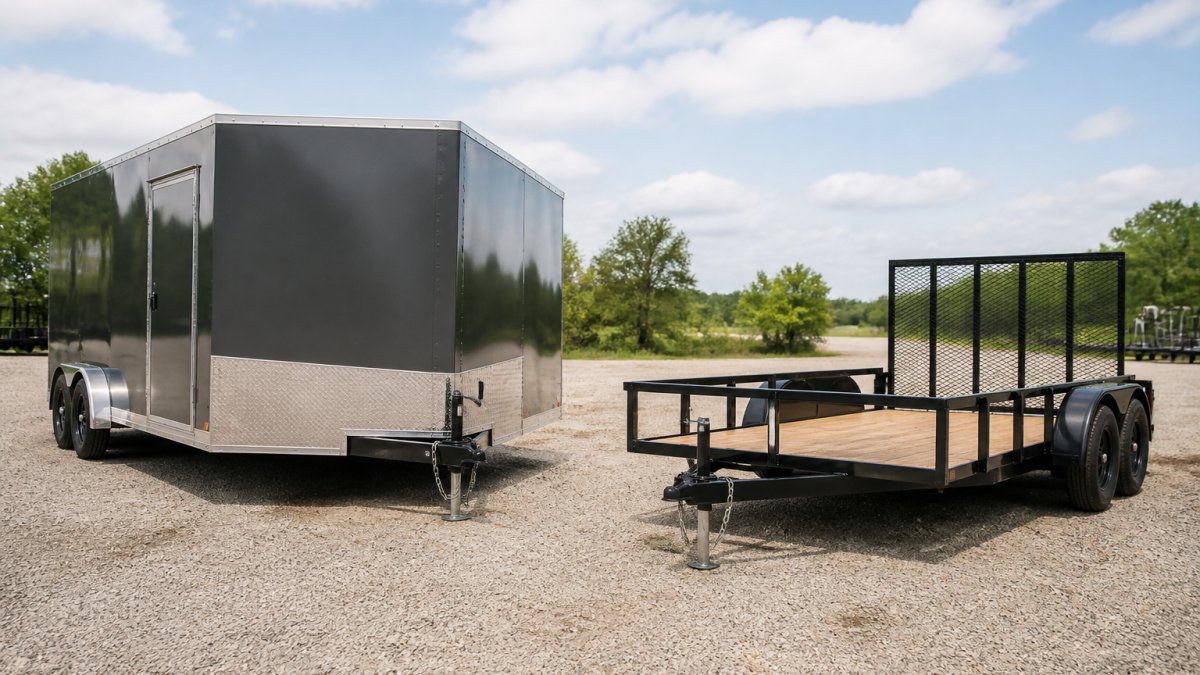
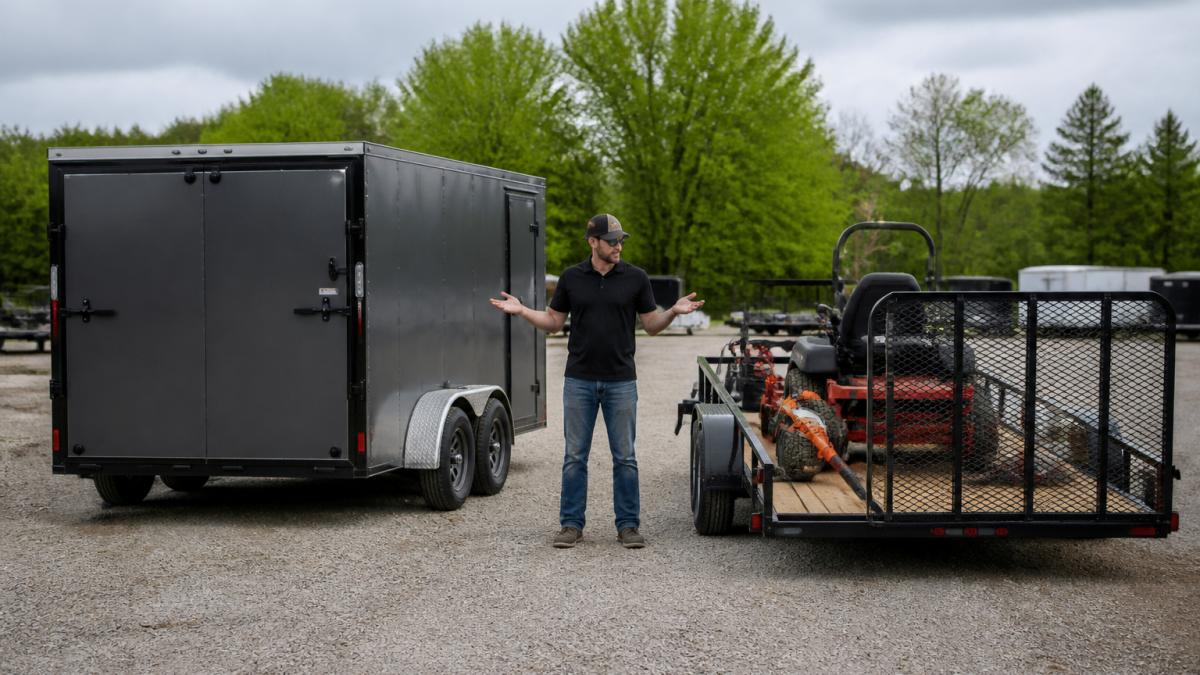
Choosing between an enclosed and a utility trailer comes down to one question: does your cargo need a roof? An enclosed trailer is a fully boxed cargo trailer with walls, a roof, and lockable doors.
The short version: enclosed trailers protect cargo from weather, road debris, and theft, while utility trailers win on loading access, lower empty weight, and lower purchase price.
Federal Highway Administration towing and trailer safety guidance
What an Enclosed Trailer Is
An enclosed trailer is a cargo trailer with solid walls, a roof, and doors, designed to keep loads covered and secure during transport. Enclosed cargo trailers range from small single-axle units to large tandem-axle models.
That enclosed body changes what you can haul. Equipment stays dry, tools stay out of sight, and cargo doesn't need a tarp. The trade-off is weight: all that structure adds empty weight, which cuts into payload capacity and demands more from your tow vehicle.
What a Utility Trailer Is
A utility trailer is an open trailer with a flat deck, side rails, and no roof, built for hauling equipment, materials, and irregular loads. Utility trailers are the workhorses of landscaping, construction, and farm work.
The open bed keeps empty weight low and loading simple. What it doesn't do is protect cargo from rain, snow, mud, or theft. Anything you haul is exposed to road conditions and to anyone who passes by.
Key Differences Between Enclosed and Utility Trailers
The core differences come down to protection, access, weight, and cost. Enclosed trailers trade loading flexibility for cargo protection and security. Utility trailers trade protection for easier loading and a lighter, cheaper build.
| Feature | Enclosed Trailer | Utility Trailer |
|---|---|---|
| Cargo protection | Full weather and debris protection | Exposed to weather and road debris |
| Security | Lockable doors, out of sight | Open, needs locks and tie-downs |
| Loading access | Rear and side doors, limited overhead | Open deck, ramps, any-side access |
| Empty weight | Higher | Lower |
| Aerodynamics | Boxier, more drag | Lower profile, less drag |
| Purchase price | Higher | Lower |
Enclosed Trailer Pros and Cons
The biggest advantage of an enclosed trailer is cargo protection. Tools, furniture, electronics, and equipment stay dry through rain, snow, and road debris, and lockable doors keep valuables out of sight. For anyone hauling goods with resale value, that matters.
Enclosed trailer pros and cons break down like this:
- Pros: weather protection, theft deterrence, no tarping, usable as mobile storage, better for finished goods and vehicles.
- Cons: higher purchase price, more empty weight, worse fuel economy from drag, harder to load oversized items, more maintenance on doors and seals.
The one drawback buyers underestimate is access. If you regularly haul irregularly shaped cargo or load with a forklift, an enclosed trailer can slow you down.
Utility Trailer Pros and Cons
Utility trailer pros and cons start with access and cost. An open deck lets you load from any side, use ramps, and haul large or awkward items that would never fit through a door. Empty weight is lower, so a smaller tow vehicle can handle more payload.
- Pros: lower purchase price, easier loading, lighter empty weight, better fuel economy, simpler maintenance.
- Cons: no weather protection, cargo is visible and vulnerable to theft, loads need tarps and secure tie-downs, road debris can damage cargo.
Enclosed Trailer Cost and Total Cost of Ownership
Purchase price is the number buyers fixate on, and it's the least useful one.
Here's how each line item actually behaves.
- Purchase price: An enclosed trailer carries a premium for walls, roof, doors, wiring, and interior finish. A utility trailer is essentially a deck, rails, axles, and a coupler, so it costs less at every size. The premium is largest on small single-axle units and shrinks as a share of total price on large tandem-axle models.
- Registration and titling: Both trailer types register the same way in most states, and fees usually scale with empty weight and model year rather than enclosure. A heavier enclosed trailer can land in a higher fee bracket, but the difference is typically modest next to the purchase price. Check your state motor vehicle agency's trailer fee schedule before you budget.
- Insurance: Collision and comprehensive coverage on a trailer is usually priced off the trailer's value and your tow vehicle policy. Because an enclosed trailer is worth more and carries higher-value cargo, expect a higher premium for equivalent coverage. Liability for the load itself often rides on your auto policy or a commercial policy if you're hauling for business, confirm with your insurer rather than assuming.
A practical way to compare: write down your expected years of ownership, annual miles, and storage situation. Then total purchase price, estimated insurance over that period, a maintenance allowance, fuel delta, and expected resale.
For current pricing on enclosed and utility models, check our inventory or request a quote.
Trailer Size Guide: Matching the Trailer to Your Cargo
A trailer size guide starts with cargo, not budget. Measure your longest, widest, and heaviest load, then add clearance. A 6x12 enclosed trailer suits compact contractor loads, while larger equipment needs a 7x14 or bigger.
Match the trailer to the job:
- Landscaping equipment and materials: open utility trailer, 5x10 to 7x14.
- Tools and finished goods: enclosed trailer, 6x12 and up.
- Furniture and household moves: enclosed trailer for weather protection.
- Building materials and lumber: utility trailer for overhead loading.
Weight, Towing Requirements, and Safety Checks
Payload capacity decides whether a trailer works for your load, and it's the number buyers skip. The math is simple but unforgiving: payload equals the trailer's gross vehicle weight rating (GVWR) minus its empty (curb) weight. Your tow vehicle's towing capacity must cover the loaded trailer weight, and tongue weight counts against the vehicle's payload and hitch limits, not just its towing rating.
Run the numbers before you buy
Work through this sequence in order. Skipping a step is how buyers end up overloaded on the first trip.
- Weigh your cargo. Use a scale, not a guess. Include pallets, tie-downs, and anything else that rides.
- Find the trailer's GVWR and empty weight. Both are on the certification label on the trailer frame, usually near the coupler. Payload = GVWR − empty weight.
- Confirm cargo weight is under payload. If it isn't, you need a bigger trailer or a lighter load, not more straps.
- Add tongue weight. Tongue weight is the downward force at the coupler, typically targeted at roughly 10-15% of loaded trailer weight for conventional bumper-pull setups. It counts against your tow vehicle's payload and rear axle rating.
- Check the tow vehicle's ratings. Find the towing capacity, gross combined weight rating (GCWR), payload, and hitch rating in the owner's manual and on the door jamb label. The loaded trailer must fit under towing capacity, and the whole rig, vehicle, passengers, cargo, tongue weight, must fit under GCWR.
- Match the hitch and ball. The ball size, coupler class, and wiring must match the trailer. A mismatched ball is a disconnect waiting to happen.
A worked example: a trailer with a 7,000 lb GVWR and a 2,000 lb empty weight has 5,000 lb of payload. Load 4,000 lb of cargo and the trailer weighs 6,000 lb, under GVWR. At 12% tongue weight that's about 720 lb pressing down on the hitch, which has to come out of your tow vehicle's payload along with passengers and gear.
Safety checks that matter
- Load securement: Use rated straps and chains, attach to frame or rated tie-down points, not sheet metal or rails, and recheck after the first few miles. An unsecured load can shift at highway speed and cause a crash.
- Visibility and lighting: Confirm brake lights, turn signals, and clearance lights work before every trip. An enclosed trailer blocks your rear view, so mirrors must be adjusted for the trailer width.
- Braking: Trailers above a certain weight require their own brakes, and many states set that threshold by weight. Confirm your trailer's brake setup and controller match your tow vehicle.
- Tires and bearings: Check tire pressure cold, inspect for cracks and uneven wear, and pack or service bearings on schedule. A bearing failure at speed is a roadside emergency.
National Highway Traffic Safety Administration trailer safety information
Which Trailer Fits Your Work? A Decision Framework
Use this framework to settle the enclosed vs utility trailer question for your own work. Answer three questions: does the cargo need protection, how do you load it, and what can your tow vehicle handle?
- Cargo needs weather or theft protection? Choose an enclosed trailer.
- Loading with a forklift or from the side? Choose a utility trailer.
- Tight towing capacity? Choose a lighter utility trailer.
- Hauling finished goods or vehicles? Choose an enclosed trailer.
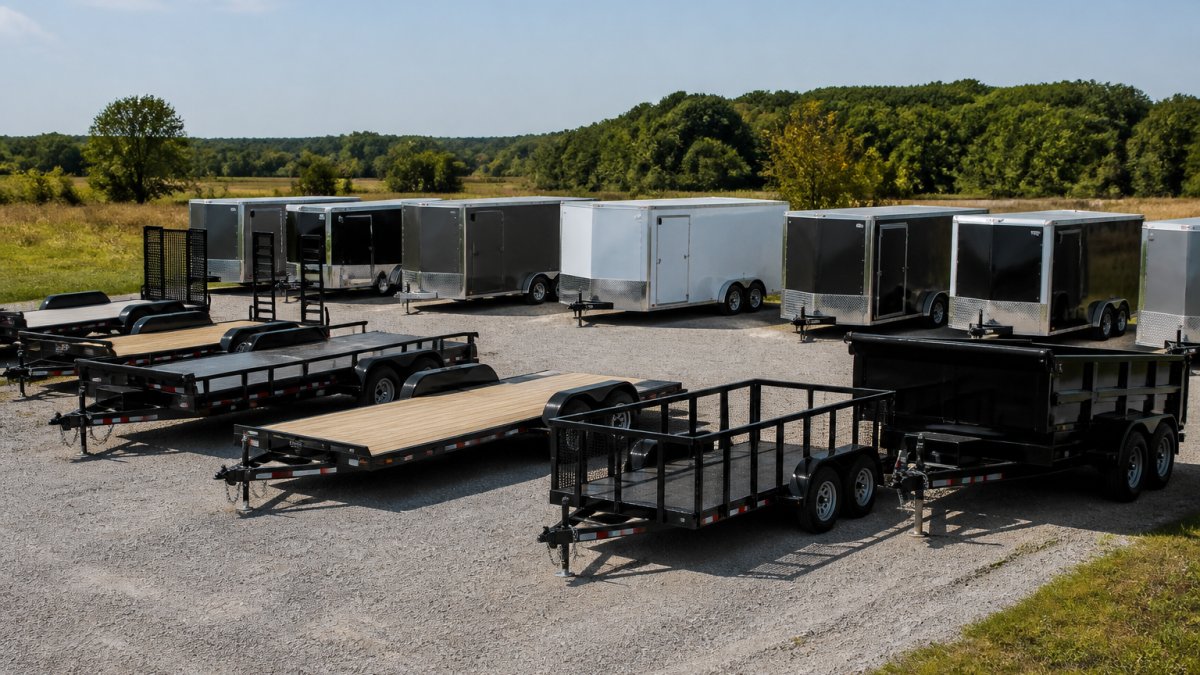
For buyers who want both options from one dealer, DoubleTake Trailer Sales carries enclosed, utility, dump, and car hauler models, plus custom builds and financing.
Frequently Asked Questions
Is a utility trailer the same as an enclosed trailer?
No. A utility trailer has an open bed with low side rails and no roof, so cargo sits exposed to weather and road debris. An enclosed trailer has solid walls, a roof, and lockable doors that fully contain the load. The enclosed vs utility trailer decision comes down to protection versus open access: utility trailers make loading oversized or irregular cargo faster, while enclosed trailers shield tools, furniture, and equipment from rain, snow, and theft.
Are enclosed trailers harder to pull?
They usually weigh more empty than a comparable utility trailer, and the tall box shape catches more wind, which can lower fuel economy on the highway. That extra weight counts against your payload capacity, so check your tow vehicle's rating before buying. On the plus side, an enclosed trailer keeps cargo out of the slipstream, and a properly loaded trailer with correct tongue weight tracks steadily at highway speeds.
Is an enclosed trailer worth the extra cost?
It depends on what you haul. Enclosed trailer cost runs higher up front than an open utility trailer, but the walls and roof protect cargo from weather, road debris, and theft, and they cut cleaning and replacement costs over time. Contractors hauling power tools, mobile vendors, and anyone storing equipment between jobs often find the total cost of ownership favors enclosed. For gravel, mulch, and building materials, a utility trailer is the practical pick.
How do I choose the right trailer size for my load?
Start with the longest and tallest item you will haul, then add clearance for tie-downs and walk-around space. A 6x12 enclosed trailer suits compact equipment and small business loads, while 7x14 and 7x16 sizes fit larger tool collections and furniture runs. Use a trailer size guide to match deck length, width, and payload capacity to your cargo, and confirm your tow vehicle's towing capacity covers the trailer's empty weight plus the load.
Which trailer is better for hauling equipment?
For most contractors, an enclosed trailer wins because lockable doors and solid walls protect equipment from theft, rain, and road debris, and the trailer doubles as secure storage on site. Utility trailers still make sense for equipment that will not fit through a door, such as riding mowers, ATVs, and skid-steer attachments. Match the choice to your cargo: enclosed for tools and sensitive gear, open for oversized or dirty loads.
The right trailer protects your cargo and your investment, and the wrong one costs you time on every job. If you're still weighing an enclosed vs utility trailer, our team at DoubleTake Trailer Sales can help you compare models side by side. We offer in-stock inventory, custom builds to your specs, flexible financing, and an in-house service and parts department. Get started with DoubleTake Trailer Sales and find the trailer built for your work.