 ultimate-guide
Heavy Duty Dump Trailer Buying Guide for 2026
Table of Contents
- How to Choose a Heavy Duty Dump Trailer: What Actually Matters
- Dump Trailer GVWR Explained: Payload, Axles, and Towing Capacity
- Steel vs Aluminum Dump Trailers: Which Holds Up Better?
- Hydraulic Hoist Systems, Bed Construction, and Braking Safety
- Gooseneck vs Bumper Pull: Matching the Trailer to Your Truck
- Heavy Duty Dump Trailer Maintenance Checklist: Keep It Working
- Used vs New, Licensing, and Long-Term Cost of Ownership
- Conclusion
- Frequently Asked Questions
Last Updated: October 2, 2026
How to Choose a Heavy Duty Dump Trailer: What Actually Matters
A heavy duty dump trailer buying guide starts with one question: what will you actually haul, and how often? Get that wrong and every other spec becomes noise.
Quick Comparison: Key Specs at a Glance
| Spec | Light Duty | Heavy Duty | What It Decides |
|---|---|---|---|
| GVWR | 7,000-10,000 lb | 14,000-16,000 lb | Legal load limit |
| Steel gauge | 12-14 gauge floor | 7-10 gauge floor | Dent resistance |
| Hoist type | Single-cylinder | Scissor or telescopic | Dump angle and cycle time |
| Axles | Single | Tandem | Weight distribution |
| Brakes | Surge | Electric with controller | Stopping control |
| Hitch | Bumper pull | Gooseneck or bumper pull | Towing stability |
Dump Trailer GVWR Explained: Payload, Axles, and Towing Capacity
GVWR is the maximum total weight a trailer can carry: its own weight, cargo, and tongue load. Payload capacity is GVWR minus empty weight, a 14,000 lb GVWR trailer weighing 4,000 lb empty hauls 10,000 lb.
The 60/40 Rule for Tongue Weight
Aim for 10-15% of loaded trailer weight on the tongue for bumper pull, 15-25% for gooseneck. Too little and the trailer sways; too much and your rear axle and steering suffer.
Steel vs Aluminum Dump Trailers: Which Holds Up Better?
Steel wins for most heavy hauling. Aluminum saves weight and raises payload capacity, but costs more and dents rather than flexes under impact.
- Steel: heavier, cheaper to repair, tolerates gravel and concrete abuse
- Aluminum: lighter, resists rust, better for frequent hauling where every pound counts
- Powder coat finish: protects steel from corrosion, but chips need touching up
Hydraulic Hoist Systems, Bed Construction, and Braking Safety
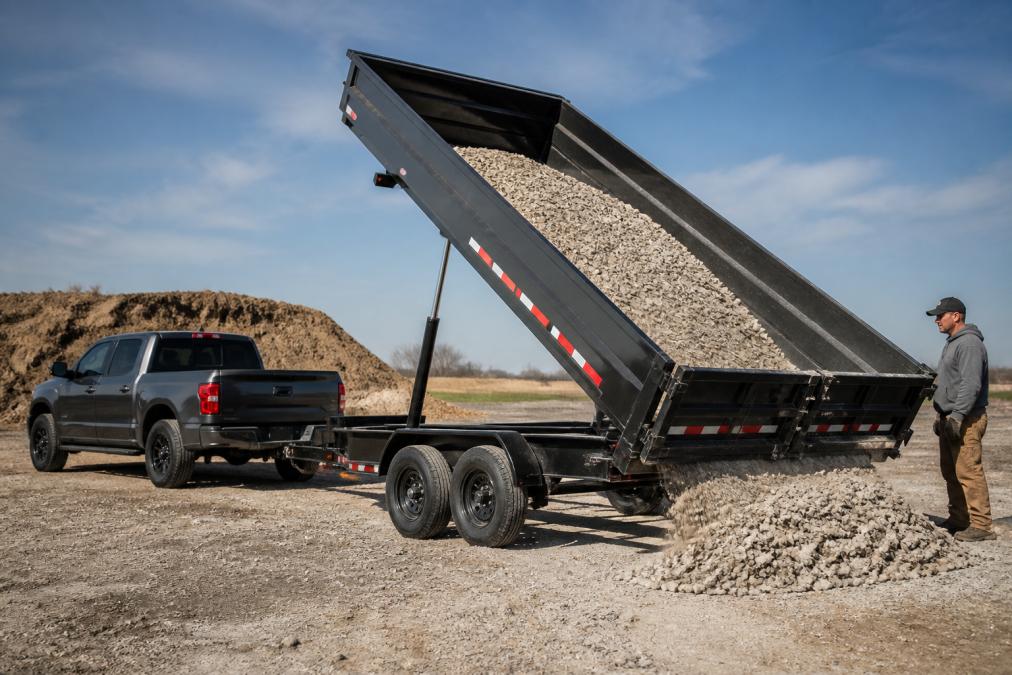
Three systems decide whether a dump trailer feels solid or flimsy: the hoist, the deck, and the brakes. A hydraulic hoist uses a pump, reservoir, and cylinder to raise the bed. Cycle time and dump angle matter more than cylinder count.
Scissor vs Telescopic Hoists
Scissor hoists push the bed up from the middle, deliver a high dump angle, and suit shorter beds. Telescopic hoists extend from the front, handle longer beds, and lift heavier loads with less frame stress.
Gooseneck vs Bumper Pull: Matching the Trailer to Your Truck
Most guides stop at "gooseneck is more stable." True, but that doesn't tell you whether your truck can pull the trailer you're looking at. Hitch style is half the decision; the other half is a compatibility check between loaded trailer weight and your truck's ratings.
Start With Your Truck Class, Not the Trailer
Truck class sets the ceiling before hitch style enters the picture. The ratings below are typical published maximums for properly equipped trucks; your door-jamb sticker is the only number that legally counts.
| Truck Class | Typical Example | Typical Max Tow Rating | Realistic Loaded Trailer Ceiling |
|---|---|---|---|
| Half-ton (Class 2) | F-150, Silverado 1500, Ram 1500 | 8,000-13,000 lb | 7,000-10,000 lb GVWR bumper pull |
| Three-quarter ton (Class 2b/3) | F-250, Silverado 2500, Ram 2500 | 14,000-20,000 lb | 14,000 lb GVWR, gooseneck preferred |
| One-ton (Class 3) | F-350, Silverado 3500, Ram 3500 | 20,000-35,000 lb | 16,000 lb GVWR and up, gooseneck |
| Class 4-5 (medium duty) | F-450/F-550, Ram 4500/5500 | 24,000-37,000 lb | 16,000-21,000 lb GVWR, gooseneck only |
The Compatibility Checklist
Before you commit to a trailer, run this against your truck:
- Confirm the truck's GVWR, GCWR, and payload from the door-jamb certification label, not the brochure
- Confirm the truck's maximum tow rating for your specific cab, bed, axle ratio, and drivetrain
- Confirm the receiver hitch class and rating (Class III/IV for bumper pull, or a gooseneck ball rated for the load)
- Confirm the truck has a factory or aftermarket trailer brake controller, surge brakes are not a substitute on heavy units
- Confirm the truck's rear axle and tire load ratings exceed the loaded tongue weight plus cargo
- Confirm the combined loaded weight (truck + trailer + cargo + passengers) stays under GCWR
When Gooseneck Actually Wins
Gooseneck hitches place the load over or slightly ahead of the rear axle, doing three things a bumper pull can't:
- Removes tongue weight from the receiver and distributes it across the truck's frame, so a properly equipped three-quarter-ton or one-ton truck can pull a heavier trailer without exceeding rear-axle ratings.
- Eliminates sway because the pivot point sits over the axle rather than behind it. Crosswinds and passing semis affect a gooseneck far less.
- Tightens turning geometry, a gooseneck can turn sharper in a job site without jackknifing the way a bumper pull can.
The Rule of Thumb
Under about 10,000 lb loaded and towing a few times a month? Bumper pull with a weight-distributing hitch and brake controller is the practical choice. Regularly at 12,000 lb GVWR or above, towing long distances, or hauling highways? Gooseneck is worth the setup cost, but only behind a three-quarter-ton or larger truck with matching payload.
Heavy Duty Dump Trailer Maintenance Checklist: Keep It Working
A heavy duty dump trailer maintenance checklist protects the parts that fail first. Lubrication, brakes, tires, and hydraulics cover most breakdowns.
- Grease the hoist pins and hinges every 50 hours of use
- Check hydraulic fluid level and look for leaks at the pump and cylinder
- Inspect brake shoes, drums, and wiring at each service
- Verify tire ply rating and pressure against the sidewall spec
- Test the breakaway battery and charge it monthly
- Check safety chains, coupler, and tongue weight before each haul
Used vs New, Licensing, and Long-Term Cost of Ownership
Purchase price is the smallest number in the ownership equation. Registration, insurance, brakes, tires, hydraulics, and resale value matter more, buyers who plan for those up front make better decisions on day one.
Used Trailer Inspection Checklist
A used heavy duty dump trailer can be the better buy, if the bones are sound. Structural fatigue and hydraulic leaks turn bargains into money pits. Run this checklist with the trailer unhooked and the bed down, then again with the bed raised.
Frame and structure (bed down):
- Inspect the main frame rails for cracks, especially at weld joints near the tongue and axle hangers
- Look for rust that has scaled or pitted the steel, surface rust is cosmetic, flaking rust is structural
- Check cross-members for bends or separation from the floor
- Confirm the GVWR certification label matches the axles and tires actually installed (mismatched plates are a red flag)
- Check the floor for waves, soft spots, or patches, a patched floor usually hides a bigger problem
- Inspect the tongue, coupler, and safety chain attachment points for cracks or elongation
Hydraulics and hoist (bed raised, supported):
- Cycle the bed through a full raise and lower, listen for pump whine, watch for hesitation
- Inspect the cylinder rod for pitting, scoring, or hydraulic fluid weeping at the seals
- Check the reservoir level and the condition of the fluid (dark or milky fluid means water intrusion or neglect)
- Look under the trailer and around the pump for fresh drips after the cycle
- Confirm the bed holds position under load without creeping down
Brakes, tires, and electrical:
- Pull the wheels and measure brake shoe thickness, worn shoes on a heavy trailer are a safety issue, not a bargaining chip
- Check tire date codes (the four-digit DOT code on the sidewall), tires over six to seven years old should be replaced regardless of tread
- Verify all lights, the breakaway switch, and the breakaway battery
- Test the brake controller connection with the tow vehicle before money changes hands
Registration, Titling, and Licensing
Trailer registration and titling are handled at the state level, and requirements vary widely. In general:
- Registration and title: Most states require a title and registration for trailers above a certain weight threshold (commonly 3,000-4,000 lb unladen, but this varies). Bring the bill of sale, the trailer's certificate of origin or prior title, and a weight certificate if your state requires one.
- License plates: Many states issue permanent or multi-year trailer plates; others require annual renewal. Confirm with your state motor vehicle agency before you tow it home.
- Commercial driver's licensing: Under federal rules administered by the FMCSA commercial vehicle and trailer regulations, a commercial driver's license (CDL) is generally required when the combination vehicle's GVWR reaches 26,001 lb or more, or when the towed trailer exceeds 10,000 lb and the combination is used for commerce. Some states impose stricter thresholds. If you're hauling for business, confirm your state's rules before you buy, the trailer's GVWR, not its actual load, is what triggers the requirement.
- Insurance: Trailers are typically covered under the tow vehicle's policy while attached, but a standalone trailer policy is often required for titled trailers and is worth carrying for theft and liability.
Long-Term Cost of Ownership
Beyond the sticker, plan for these recurring costs. Exact figures vary by region, trailer size, and use intensity, but the categories are consistent:
| Cost Category | Typical Interval | Notes |
|---|---|---|
| Tires | Every 4-7 years or on wear | Heavy-duty trailer tires are a significant line item; buy by load range, not price |
| Brake shoes and drums | Every 15,000-30,000 miles of towing | More often with heavy loads and stop-and-go work |
| Hydraulic fluid and filter | Annually or per manufacturer interval | Cheap insurance against pump failure |
| Cylinder seals and hoses | Every 3-7 years | Leaks are the most common hydraulic failure |
| Grease and lubrication | Every 50 hours of use | Hoist pins, hinges, and coupler |
| Registration and insurance | Annually or per state cycle | Varies by state and declared value |
| Battery (breakaway) | Every 2-4 years | Test monthly, replace on schedule |
New vs Used: The Honest Trade-Off
| Factor | New | Used |
|---|---|---|
| Warranty | Manufacturer coverage on frame, axles, and hydraulics | Usually none, or transferable remainder |
| Known history | None needed | Depends entirely on inspection |
| Entry price | Higher | Lower |
| Immediate repair risk | Low | Moderate to high without inspection |
| Resale value | Depreciates fastest in year one | Already absorbed the steepest depreciation |
Conclusion
Choosing the right trailer comes down to matching GVWR, payload, and hoist type to how you actually work. Get those three right and the rest follows. DoubleTake Trailer Sales builds and stocks dump, utility, enclosed, and concession trailers, with custom builds to your specs, no credit check financing options, and an in-house service and parts department. Customers consistently mention the smooth, no-pressure process, from a custom build delivered in about five weeks to a concession trailer in stock and ready to tow.
Frequently Asked Questions
What should I look for when buying a heavy duty dump trailer?
Start with the GVWR and payload capacity to confirm it matches your truck's towing capacity and your typical loads. Check the steel gauge of the bed and frame, the hydraulic hoist type, axle ratings, and brake setup. Look at cross-member spacing, powder coat finish, and whether the trailer includes a tarp system, ramps, and a breakaway kit. DOT compliance matters too. A trailer that meets these specs will handle daily job site use without constant repairs.
How do I determine the correct GVWR for my dump trailer?
Add the empty trailer weight to the heaviest load you plan to haul, then add a safety margin. Your truck's towing capacity and tongue weight rating must cover that total. Check the driver's door sticker on your truck for its specific ratings. If you routinely haul gravel, dirt, or demolition debris, size up rather than down. A trailer running at its limit every day wears faster than one with headroom.
Are hydraulic scissor lifts better than telescopic hoists for heavy duty use?
Both work. Scissor hoists spread lifting force across the frame and handle uneven loads well, which suits dump trailers used for mixed debris. Telescopic hoists reach higher dump angles and work well for sticky materials like wet clay. For heavy duty daily use, scissor systems are common because they are simpler to maintain and less exposed to damage. Match the hoist to what you actually haul, not to the spec sheet alone.
What maintenance is required for a heavy duty dump trailer?
Check hydraulic fluid levels and look for leaks before each use. Grease the hoist pivot points and hinges monthly. Inspect brake wiring, the breakaway kit, and safety chains regularly. Check tire pressure and tread depth weekly. Repack wheel bearings annually or every 12,000 miles. Touch up any chips in the powder coat finish to prevent rust. Keep the battery charged for the hydraulic pump. A written log makes it easier to spot recurring issues.
Is a steel or aluminum dump trailer better for heavy duty work?
Steel costs less upfront, handles heavier loads, and is easier to repair if damaged. It weighs more and can rust if the finish is compromised. Aluminum resists corrosion, weighs less, and lets you haul more payload within the same GVWR. It costs more and can dent under impact. For contractors hauling rock and demolition debris daily, steel is the common choice. For hauling lighter materials where corrosion is a concern, aluminum earns its price.
What is the difference between a light-duty and heavy-duty dump trailer?
Light-duty trailers typically run single axles, thinner steel, and lower GVWR, which suits occasional homeowner use. Heavy-duty models use tandem or triple axles, thicker steel gauge, higher payload capacity, and stronger hoist systems. They also include better brakes, heavier frames, and more cross-member support. If you haul daily or move dense materials, heavy-duty construction lasts longer and holds its resale value better.
What is the 60/40 rule for trailers?
The 60/40 rule says 60 percent of the cargo weight should sit in front of the trailer axle and 40 percent behind it. This keeps enough tongue weight on the hitch to prevent sway. Too little tongue weight causes fishtailing at highway speed. Too much overloads your truck's rear axle. Load dense material toward the front, then check tongue weight with a scale before towing. This matters most when hauling uneven loads like equipment or mixed debris.
Do I need a special license to tow a heavy duty dump trailer?
It depends on the combined weight of the trailer and load. Many states require a Class A or Class B commercial license when the trailer's GVWR exceeds 10,000 pounds, though exemptions exist for recreational use. Some states also require trailer registration, annual inspections, and a brake controller for trailers over certain weights. Check your state's DMV rules before you buy. The dealer can often confirm what applies to your setup.