 How-to
Can You Finance a Used Trailer? What Buyers Need to Know
Last Updated: November 19, 2026
Quick Summary
Yes, you can finance a used trailer, and most dealerships and lenders treat it much like financing a vehicle. You apply, a lender reviews your credit and income, and if approved, you make a down payment and pay the balance over time. Age, condition, and paperwork decide whether a lender says yes.
- Dealership financing is often the fastest option because dealers work with lenders who understand trailers.
- Secured loans use the trailer as collateral and usually mean a lower rate and easier approval.
- Most trailer loans run from two to seven years, and older used trailers often cap at shorter terms.
- Get preapproved before you shop when financing a used trailer from a private seller.
- A declined application can be overcome with a larger down payment, a co-signer, or paying cash.
Table of Contents
- Can You Finance a Used Trailer? The Short Answer
- Trailer Financing Options: Dealership, Bank, and Credit Union Loans
- Used Trailer Financing With Bad Credit: What Lenders Actually Look At
- Using a Trailer Financing Calculator to Estimate Monthly Payments
- Trailer Loan Terms and Repayment Length: How Long Can You Stretch It?
- Financing a Used Trailer From a Private Seller: Due Diligence and Title Transfer
- When a Lender Declines: Alternatives to Trailer Financing
- Apply for Used Trailer Financing at DoubleTake Trailer Sales
- Frequently Asked Questions
Can You Finance a Used Trailer? The Short Answer
Yes, you can finance a used trailer, and most dealerships and lenders treat it much like financing a vehicle. The process is simpler than most people expect. You apply, a lender reviews your credit and income, and if approved, you make a down payment and pay the balance over time.
The details matter, though. Age, condition, and paperwork decide whether a lender says yes. Below, we break down each option, what lenders check, and how to avoid the mistakes that sink an application.
Trailer Financing Options: Dealership, Bank, and Credit Union Loans
Three main paths exist for a trailer loan: dealership financing, a bank loan, or a credit union loan. Dealership financing is often the quickest option because the dealer typically works with lenders who understand trailers. Banks and credit unions often offer lower interest rates, but approval takes longer and the lender may not know how to value a trailer.
Here is how the three compare:
| Option | Speed | Best For | Watch Out For |
|---|---|---|---|
| Dealership financing | Fast, often same day | Buyers who want one stop | May work with a limited lender pool |
| Bank loan | Moderate | Strong credit, lower rate | Slower approval, trailer valuation questions |
| Credit union | Moderate | Members, competitive rates | Membership required |
Secured vs. Unsecured Trailer Loans
A secured loan uses the trailer itself as collateral, which usually means a lower interest rate and easier approval. An unsecured loan relies only on your credit and income, so rates run higher and approval is stricter. Most trailer financing is secured, and that is generally the better route for a used trailer purchase.
Used Trailer Financing With Bad Credit: What Lenders Actually Look At
Lenders weigh more than your credit score when you apply for used trailer financing with bad credit. They look at your credit history, debt-to-income ratio, proof of income, employment information, down payment size, and the trailer's age and condition. A low score is a hurdle, not an automatic denial.
A common mistake is applying to several lenders in a short window without checking terms first. Each application can trigger a credit inquiry. Prequalification lets you see estimated offers without the same impact, so start there. If your credit needs work, our guide on financing trailers with poor credit walks through the steps, and you can also compare trailer financing for bad credit to see which options fit your situation.
Using a Trailer Financing Calculator to Estimate Monthly Payments
A trailer financing calculator estimates your monthly payment from three inputs: loan amount, interest rate, and loan term. Enter the trailer price minus your down payment as the loan amount, then adjust the term to see how the payment changes.
The math is straightforward. A longer term lowers the monthly payment but raises the total interest you pay. A shorter term does the opposite. Run the numbers before you shop so you know your real budget, not just the sticker price. A calculator also shows the annual percentage rate's effect, which matters more than the advertised rate alone.
Trailer Loan Terms and Repayment Length: How Long Can You Stretch It?
Most trailer loans run from two to seven years, depending on the loan amount and the trailer's age. Newer trailers usually qualify for longer terms. Older used trailers often cap at shorter repayment schedules because lenders tie the term to the trailer's useful life, a 15-year-old utility trailer may only qualify for a 36- or 48-month loan even if the amount would otherwise support a longer term. Ask the lender for the maximum term on the specific trailer before you assume a payment.
Stretching the term lowers monthly payments but increases total cost. Here is how the same loan amount behaves at different terms, using a hypothetical $15,000 loan at a 9% annual percentage rate (APR):
| Term | Approximate monthly payment | Approximate total interest | Approximate total paid |
|---|---|---|---|
| 36 months | $477 | $2,172 | $17,172 |
| 48 months | $373 | $2,904 | $17,904 |
| 60 months | $311 | $3,660 | $18,660 |
| 72 months | $270 | $4,440 | $19,440 |
Those figures are illustrative and exclude fees, taxes, and registration. The pattern is what matters: each additional year of term buys a smaller monthly payment at the cost of more total interest. A five-year loan on the same amount costs roughly $1,500 more in interest than a three-year loan at the same rate.
APR is the number to compare, not the advertised rate. APR folds in the interest rate plus most lender fees, so two offers with the same quoted rate can have different APRs once origination or documentation fees are included (What is the difference between a loan interest rate and the APR?).
Pick the shortest term you can comfortably afford while keeping the payment sustainable. If you are still deciding what to buy, our heavy duty dump trailer buying guide covers trailer types and how pricing works before you commit to a term.
Monthly Payment and Total Interest by Loan Term on a $15,000 Loan at 9% APR
Financing a Used Trailer From a Private Seller: Due Diligence and Title Transfer
Financing a used trailer from a private seller is possible, but the sequence matters more than with a dealership because no one is coordinating the paperwork for you.
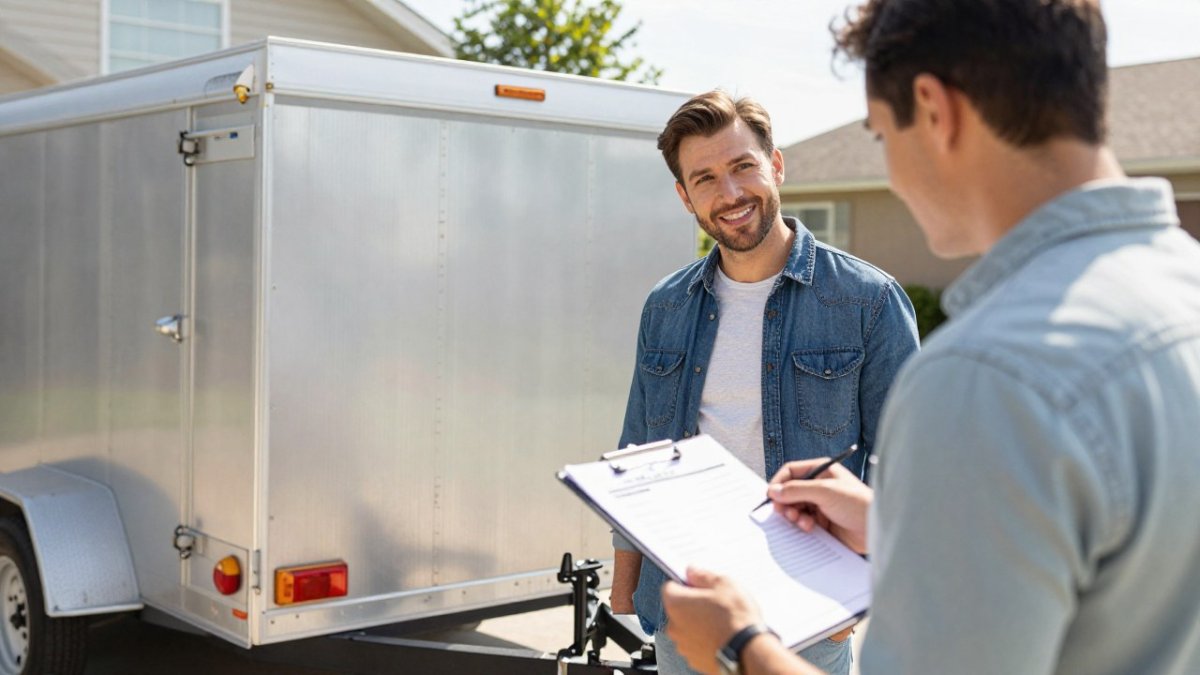
A practical order of operations looks like this:
- Get preapproved before you shop. Tell the lender the amount you need and that the seller is a private party. Ask upfront whether they finance private sales, what loan-to-value they allow on a used trailer, and whether they require an inspection.
- Verify ownership and lien status. Ask the seller for the original certificate of title. The seller's name on the title must match their government-issued ID. Check the title for a listed lienholder; if one appears, the lender must be paid off and the lien released before title can transfer cleanly. Ask the seller for a paper title or a lien-release letter from the prior lender if the title is electronic.
- Match the VIN or serial number. Confirm the number stamped on the trailer frame or data plate matches the title and the bill of sale. A mismatch is a stop sign, walk away rather than try to fix it after money changes hands.
- Inspect before you commit. Check the frame for cracks or rust-through, the coupler and safety chains, tires for date codes and uneven wear, brakes and breakaway systems on heavier trailers, lights and wiring, and the floor or deck. Lenders that require an inspection usually want it done by a licensed inspector, not the seller.
- Put the agreement in writing. The bill of sale should list the seller and buyer legal names, the VIN or serial number, the sale price, the date, and a statement that the seller transfers clear title free of liens. Some motor vehicle or trailer registration offices publish a bill-of-sale form you can use.
- Coordinate funding and title transfer. Lenders generally do not hand a check to a private seller without securing their interest, and the title transfer and lien recording are typically coordinated through the title office or a title company.
Watch out: paying a private seller before the title transfer and lien recording are complete leaves you with little recourse if the paperwork turns out to be wrong, and it can leave the lender unwilling to fund the loan.
Expect the process to take longer than a dealership purchase, because the lender is verifying a transaction it did not originate. Ask your lender which steps they handle and which fall to you so nothing stalls at the title office.
When a Lender Declines: Alternatives to Trailer Financing
A declined application is not the end of the road. Buyers have several fallbacks: a larger down payment, a co-signer with stronger credit, a no credit check financing option, or paying cash for a lower-priced trailer. Some sellers offer lease options or rent-to-own arrangements, though these usually cost more over time.
If you plan to buy outright, our best trailer brands for contractors guide helps you judge which trailers are worth the cash.
Apply for Used Trailer Financing at DoubleTake Trailer Sales
The fastest way to know where you stand is to start an application with a dealer who finances trailers. We are a locally-owned dealership established in 2010, and we offer flexible financing options. Our team also handles custom builds to your specifications and offers in-house service and parts support.
Bring your employment information, proof of income, and a sense of your down payment, and we will help you compare loan offers and find a payment schedule that fits. Get started with DoubleTake Trailer Sales and drive off with the right trailer for the job.
Financing a used trailer comes down to preparation: know your budget, check your credit, and pick the lender that fits your situation. DoubleTake Trailer Sales makes that easier with flexible financing options, custom trailer builds, and a service and parts department that stays with you after the sale.
Frequently Asked Questions
Is it hard to get financed for a used trailer?
It depends on your credit profile and the lender. Prime borrowers with steady income and a credit score in the upper tier usually qualify through banks and credit unions with standard documentation. Subprime borrowers may need dealership financing, a larger down payment, or a co-signer. Some dealerships offer no credit check financing options, though these often carry higher rates or fees. Getting prequalified with two or three lenders before you shop gives you a realistic picture of your loan amount and monthly payments.
Can you finance a used trailer with bad credit?
Yes, used trailer financing with bad credit exists, but expect tighter terms. Lenders weigh your credit score, credit history, debt-to-income ratio, and down payment together, so a larger down payment can offset a lower score. Dealership financing tends to be more flexible than bank loans for subprime borrowers. Prequalification helps you see your actual rate without a hard credit inquiry. Compare loan offers from at least two sources before signing, and check whether the lender reports payments to the credit bureaus so on-time payments rebuild your history.
Can you get a trailer loan when buying from a private seller?
It is possible but harder than dealer financing. Many banks and credit unions will finance a private-party purchase if you provide the trailer's year, make, model, VIN, and a bill of sale, and if the trailer meets the lender's age and condition requirements. Some lenders require an inspection or appraisal first. Financing a used trailer from a private seller also means you handle the title transfer yourself, so confirm the title is clear of liens before money changes hands. Verify ownership documents and complete the title transfer with your state motor vehicle agency.
How many years can you finance a trailer?
Trailer loan terms and repayment length typically range from two to seven years, depending on the loan amount, trailer age, and lender. Newer and higher-value trailers usually qualify for longer terms, which lowers the monthly payment but increases the total interest you pay. Shorter terms cost less overall but strain monthly cash flow. Run the numbers in a trailer financing calculator at two or three term lengths before committing, and factor in loan fees so you see the true total cost of borrowing.
What documents do you need to apply for trailer financing?
Most lenders ask for a government-issued ID, proof of income such as recent pay stubs or tax returns, employment information, and your Social Security number so they can pull your credit. For the trailer itself, have the VIN, year, make, model, and purchase price or bill of sale ready. Self-employed buyers often need additional income documentation. Having these ready before you apply speeds up loan approval and reduces the chance of a second credit inquiry if you need to apply elsewhere.