 How-to
7 Steps to Choosing the Right Enclosed Trailer Size
Last Updated: November 7, 2026
Quick Summary
Choosing the right enclosed trailer size starts with measuring your cargo, not browsing a brochure. Measure every item's length, width, and height, add 6 to 12 inches of clearance on every side, then pick the smallest standard enclosed trailer size that meets all three minimums.
- Enclosed trailer size is the usable cargo space inside the box, measured in length, width, and height.
- Size chart figures like 6x12 or 7x14 describe the exterior footprint, so usable interior space is always smaller.
- Add 6 to 12 inches on every side for tie-downs, 4 inches of headroom, and 12 inches at the rear.
- Payload capacity is GVWR minus empty weight, and a 7x16 with a 7,000-pound GVWR and 2,200-pound empty weight carries 4,800 pounds.
- Keep roughly 10 to 15 percent of the loaded weight on the tongue to prevent sway.
Table of Contents
- Start With Cargo Measurements, Not Guesswork
- Read an Enclosed Trailer Size Chart the Right Way
- Compare Enclosed Trailer Sizes and Weights Before You Commit
- Use an Enclosed Trailer Size Calculator to Narrow the List
- 7x14 vs 7x16 Enclosed Trailer: Which Fits Your Load?
- Match Trailer Size to Towing Capacity and Loading Plan
- Build Your Trailer at DoubleTake Trailer Sales
- Frequently Asked Questions
Start With Cargo Measurements, Not Guesswork
Choosing the right enclosed trailer size starts with a tape measure, not a brochure. Measure your cargo first, then shop. A trailer that looks roomy on the lot can be a foot too short once your equipment is in the driveway.
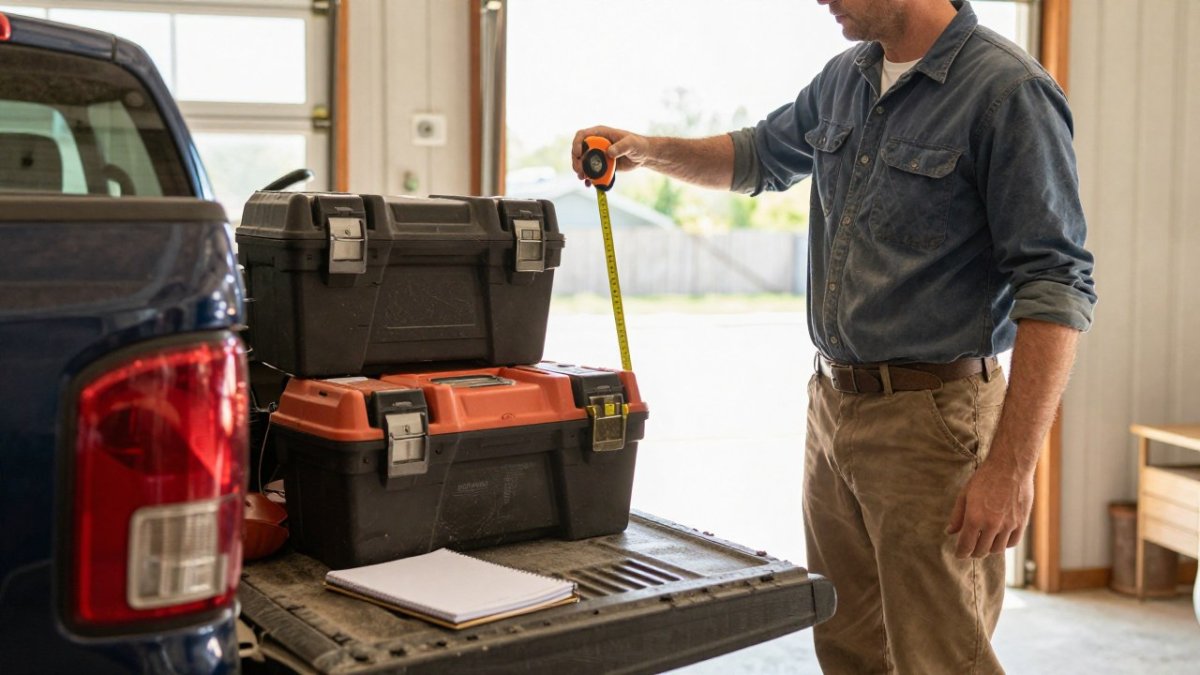
Enclosed trailer size is the usable cargo space inside the box, measured in length, width, and height. Get those three numbers right and half the buying decision makes itself.
Here is a simple measurement routine:
- List every item you plan to haul, including future purchases
- Measure each item's length, width, and height at its tallest point
- Add 6 to 12 inches of clearance on every side for tie-downs
- Measure the combined load as a group, not just item by item
Measure Length, Width, and Height of Every Item
Length is the number buyers get wrong most often.
Width matters because of wheel wells. Many enclosed trailers have fenders that intrude into the cargo space, so the floor is wider than the gap between the wheel boxes.
Height is where headroom and door height come in. A tall appliance or stacked shelving unit can clear the floor and still clip the door frame.
Account for Door Openings and Loading Clearance
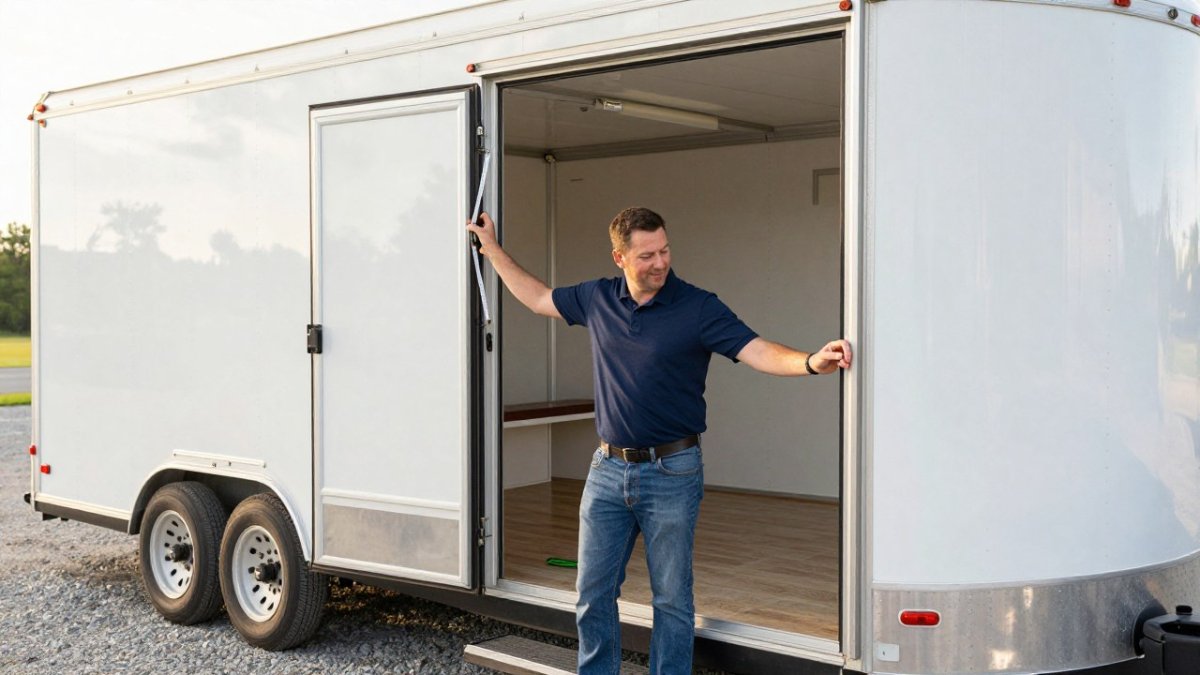
Door openings are the bottleneck nobody plans for. A rear ramp door and a side door each have their own width and height, and both can be smaller than the interior.
Ask yourself three questions before you commit:
- Does the tallest item fit through the rear door opening?
- Can you load the heaviest item without lifting it over a wheel well?
- Is there room inside to walk around the load and reach the tie-down points?
Loading clearance is a path, not a number. You need space to roll or slide an item in, then space to step around it once it is inside.
Read an Enclosed Trailer Size Chart the Right Way
An enclosed trailer size chart lists models by width and length, such as 6x12, 7x14, or 8.5x20. The first number is width in feet, the second is length.
That gap trips up first-time buyers. A trailer listed as 7 feet wide might offer closer to 6 feet 6 inches between the walls, and wheel wells eat into that again at floor level.
| Size | Typical Interior Width | Typical Interior Length | Common Use |
|---|---|---|---|
| 5x8 | About 4 ft 6 in | About 7 ft 6 in | Small tools, single mower |
| 6x12 | About 5 ft 6 in | About 11 ft 6 in | Two mowers, light equipment |
| 7x14 | About 6 ft 6 in | About 13 ft 6 in | Contractor tools, UTV |
| 7x16 | About 6 ft 6 in | About 15 ft 6 in | Mixed loads, small vehicles |
| 8.5x20 | About 8 ft | About 19 ft 6 in | Cars, large equipment |
Treat every figure in a chart as approximate. Builders vary wall thickness, and options like insulation or finished interior walls reduce the space further.
Interior Dimensions vs Exterior Dimensions
Interior dimensions are the usable cargo space between the walls, floor, and ceiling. Exterior dimensions describe the trailer's overall footprint, including fenders, tongue, and trim.
Exterior size drives storage and towing; interior size drives what you can haul. A V-nose adds a few feet of usable length up front, while a flat front gives a cleaner rectangle inside.
Ask the dealer for both sets of numbers in writing. If a listing only shows exterior figures, request the interior measurements before you buy.
Compare Enclosed Trailer Sizes and Weights Before You Commit
Weight ratings decide whether your truck can pull the trailer safely, and they matter as much as the dimensions. Three numbers control everything: GVWR, empty weight, and payload capacity.
Axle configuration changes the math. A single axle suits light loads and shorter boxes. A tandem axle spreads weight across four tires, tracks straighter at highway speed, and carries more payload.
GVWR, Payload Capacity, and a Worked Example
Here is how the math works in practice. Suppose a 7x16 enclosed trailer has a GVWR of 7,000 pounds and an empty weight of 2,200 pounds.
Now add up your load: two mowers at 900 pounds each, shelving at 300 pounds, and tools at 400 pounds. That totals 2,500 pounds, well under the 4,800-pound limit.
Watch out: payload capacity assumes the weight is spread evenly. Piling heavy items behind the axles shifts weight off the tongue and can make the trailer sway at speed.
Before you commit, read the NHTSA guidance on trailer safety and weight distribution and check your tow vehicle's owner's manual for its towing capacity and hitch rating. For brand-level guidance on which builders hold up over time, see our guide to the best trailer brands for contractors.
Use an Enclosed Trailer Size Calculator to Narrow the List
Here is a repeatable worksheet you can copy onto a legal pad. Work through it in order; each step feeds the next.
Step 1, Build the cargo inventory. List every item you plan to haul, including additions within the next two or three years. Record length, width, and height at the tallest point, plus weight if known, and note each item's footprint shape, rectangular, round, or irregular.
Step 2, Measure the load as a group. Most cargo does not pack into a perfect rectangle: two mowers side by side may be wider than either alone, and stacked shelving may be taller than the tallest unit. Lay items out on the garage floor as you intend to load them, then measure the bounding box, longest length, widest width, tallest height of the group.
Step 5, Translate to minimum interior dimensions. Minimum interior length is group length plus rear clearance plus a small front buffer.
Step 6, Round up to a standard size. Compare your minimums against the interior dimensions of standard models, 5x8, 6x12, 7x14, 7x16, 8.5x20, and pick the smallest standard size that meets or exceeds all three minimums. If you are between sizes, round up rather than squeeze.
A worked example: suppose your group measures 11 feet 6 inches long, 5 feet 4 inches wide at the widest point, and 4 feet 2 inches tall. Add 12 inches of rear clearance and 6 inches of front buffer for a minimum interior length of about 13 feet; 6 inches of side clearance for a minimum interior width of about 5 feet 10 inches; and 4 inches of headroom for a minimum interior height of about 4 feet 6 inches. A 7x14 with roughly 13 feet 6 inches of interior length and 6 feet 6 inches of interior width clears all three minimums; a 6x12 does not.
The calculator narrows the list but does not make the final call. Loading plan, axle rating, and tow vehicle limits still decide the purchase.
7x14 vs 7x16 Enclosed Trailer: Which Fits Your Load?
The 7x14 and 7x16 are two common enclosed trailer sizes, and the choice comes down to two feet of length. The 7x14 is easier to maneuver and fits tighter storage spots. The 7x16 hauls mixed loads with more breathing room.
Pick the 7x14 if:
- Your equipment fits in a tight line with little spare space
- You park in a short driveway or crowded lot
- You haul one or two machines and hand tools
Pick the 7x16 if:
- You carry equipment plus materials on the same trip
- You want room to walk around the load and reach tie-downs
- You plan to add a UTV or small vehicle later
The extra two feet costs you some maneuverability and a little more tongue weight. For most contractors hauling mixed loads, the 7x16 is the better long-term buy. If you also need a simple open trailer for lighter jobs, our roundup of the best utility trailers for small contractors covers that side of the fleet.
Match Trailer Size to Towing Capacity and Loading Plan
Towing capacity is the ceiling on everything else.
Start with your tow vehicle's ratings, all of which appear in the owner's manual and on the certification label inside the driver's door jamb:
- Gross trailer weight rating, the most the loaded trailer can weigh
- Gross combined weight rating (GCWR), the most the truck and loaded trailer can weigh together
- Hitch and ball rating, which must exceed your loaded tongue weight
- Payload rating, since passengers, fuel, and gear in the truck count against it
- Front and rear gross axle weight ratings (GAWR), which cap weight per axle
Then run the loaded-combination check in this order:
1. Weigh the loaded trailer. Load it the way you plan to haul, then weigh the trailer axles and the tongue separately at a public scale. The trailer axle weight plus the tongue weight is your gross trailer weight. Compare it to the trailer's GVWR and to the tow vehicle's gross trailer weight rating.
**2.
**3.
4. Confirm the hitch and ball rating. The hitch, ball mount, and ball each carry their own weight rating, and the lowest one is the limit.
5. Check braking requirements. Brake requirements for trailers depend on gross trailer weight, so confirm the rules that apply where you will be towing.
6. Plan the load before you leave. Heavy items go over or slightly ahead of the axles.
Before you commit, read the NHTSA guidance on trailer safety and weight distribution and check your tow vehicle's owner's manual for its towing capacity and hitch rating.
Build Your Trailer at DoubleTake Trailer Sales
Custom builds solve the sizing problem that stock trailers cannot.
That process starts with the numbers from this guide. Bring your cargo measurements, your tow vehicle's ratings, and your loading plan.
Get started with DoubleTake Trailer Sales and spec an enclosed trailer that fits your load the first time.
Sizing an enclosed trailer rewards the buyer who measures twice and buys once. The right trailer fits your cargo, your truck, and your loading routine without wasted space or white-knuckle towing.
Frequently Asked Questions
What is the 60/40 rule for trailers?
The 60/40 rule says about 60% of your loaded weight should sit ahead of the trailer axles and 40% behind, which keeps tongue weight in a safe range and reduces sway. In practice, load heavy equipment over or slightly forward of the axles and keep light items at the rear. Check tongue weight with a scale before your first long haul, then adjust tie-down points until the trailer tracks straight at highway speed.
How do I calculate the enclosed trailer size I need?
Measure the length, width, and height of every item you plan to haul, then add roughly 6 to 12 inches of clearance on each side for tie-downs and loading. Compare that total against interior dimensions, not exterior dimensions, and confirm the tallest item clears the rear door opening. Finally, subtract the empty trailer weight from the GVWR to confirm payload capacity covers your cargo weight.
Is a 7x14 enclosed trailer too big?
A 7x14 fits most single-vehicle and contractor loads and stays manageable behind a half-ton pickup, so it is rarely too big for personal or trade use. It becomes too big when your tow vehicle's towing capacity cannot handle the loaded weight or when you regularly park in tight spaces. If you haul one ATV or a small tool load, a 6x12 may be easier to maneuver and tow.
How much weight can an enclosed trailer carry?
Payload capacity equals the trailer's GVWR minus its empty weight, and it varies by axle configuration and build. A single-axle enclosed trailer typically carries far less than a tandem-axle model of the same length, so always check the data plate rather than guessing from size. Weigh your loaded trailer at a public scale to confirm you stay under both the trailer's GVWR and your tow vehicle's ratings.