 Comparison
Used vs New Custom Concession Trailers: 2026 Guide
Table of Contents
- Used vs New Custom Concession Trailers: The Core Trade-Off
- New Custom Concession Trailer Cost and What Drives It
- Used Food Trailer Inspection Checklist Before You Buy
- Concession Trailer Equipment List: What Should Come With It
- Custom Food Trailer Build Time vs Buying Off the Lot
- Total Cost of Ownership, Financing, and Warranty Coverage
- Which Should You Pick? A Decision Framework
- Conclusion
- Frequently Asked Questions
Last Updated: October 21, 2026
Used vs New Custom Concession Trailers: The Core Trade-Off
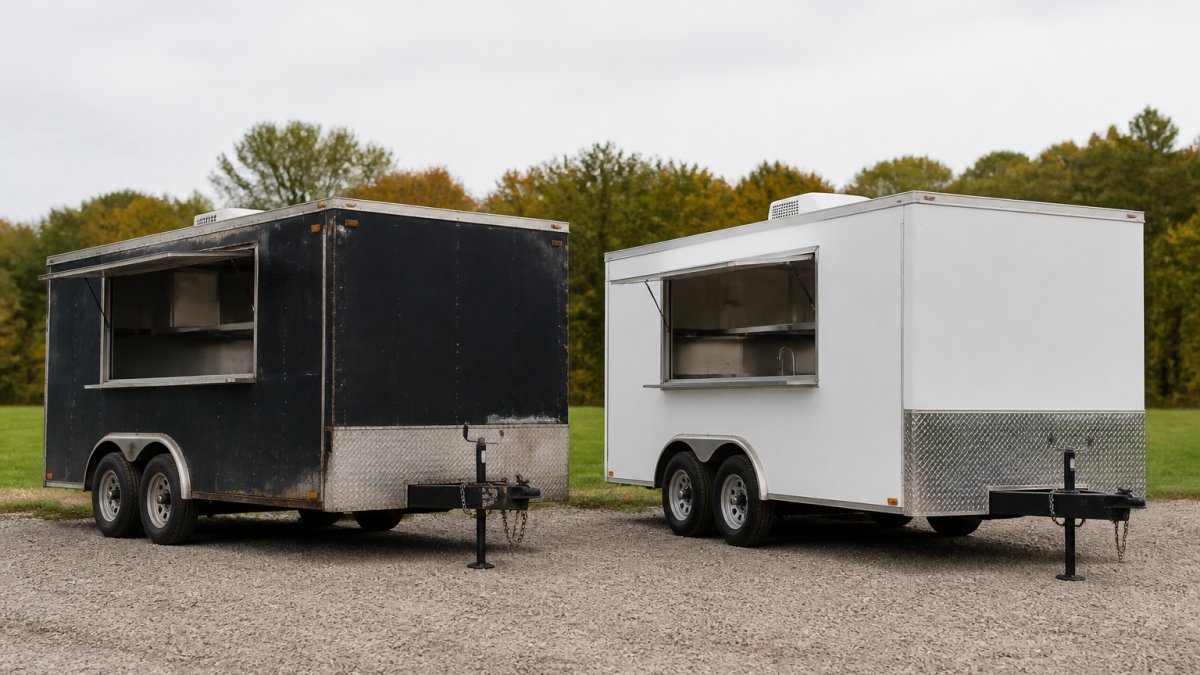
The used vs new custom concession trailers decision comes down to one question: pay less upfront and accept more risk, or pay more and buy certainty?
Used trailers lower your initial investment and often buy more trailer for the same budget.
Most buying guides frame this as a price question. It is really a risk question: a cheap used trailer that fails a health inspection costs more than you saved.
New Custom Concession Trailer Cost and What Drives It
New custom concession trailer cost depends on three things: size, equipment, and how far you push customization. A basic shell and a fully outfitted mobile kitchen sit at very different price points.
East Coast Concessions custom trailer cost guide reports custom concession trailers can run from $20,000 to $120,000 or more depending on those factors.
What moves the number most:
- Length and layout. Longer trailers need heavier frames and more materials.
- Kitchen equipment. Ranges, fryers, refrigerators, and hoods add up fast.
- Utility systems. Electrical service, propane, water tanks, and waste plumbing.
Ask any builder for a line-item quote. A single lump sum hides where your money goes.
Used Food Trailer Inspection Checklist Before You Buy
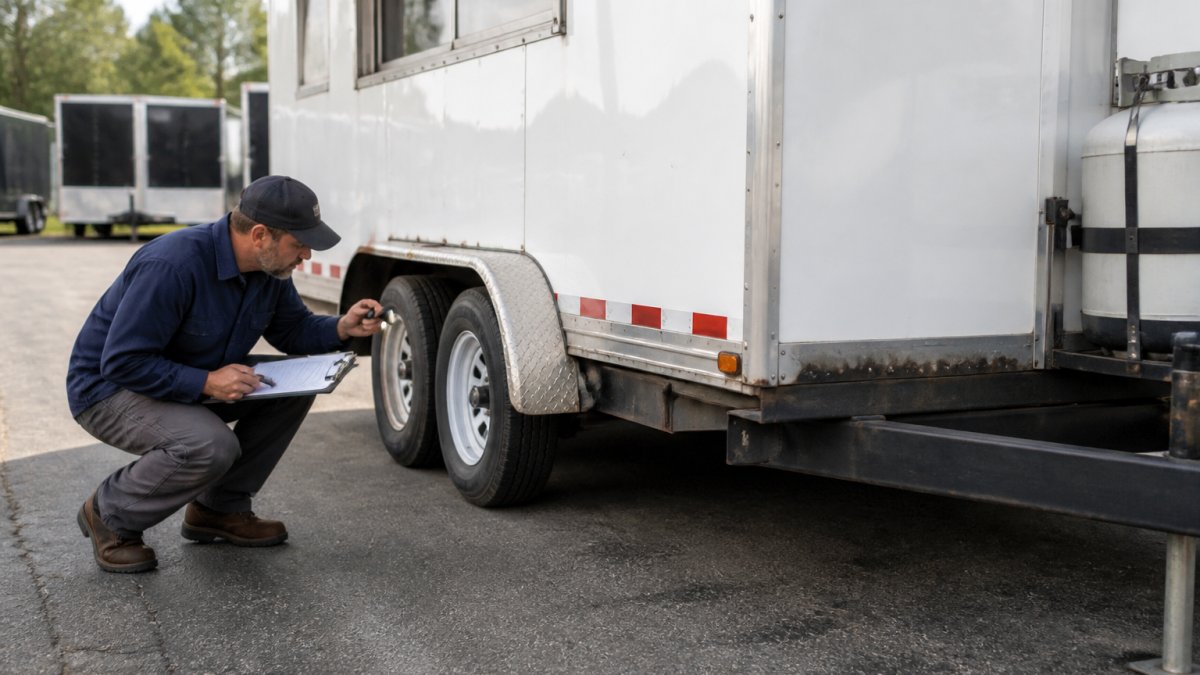
A used food trailer inspection checklist protects you from buying someone else's problem. Inspect the structure, running gear, and kitchen systems before money changes hands.
Structural and Running Gear Checks
Start underneath and work outward. Frame rust, especially around welds and the tongue, is the deal-breaker most buyers miss.
- Check the frame for rust, cracks, and previous weld repairs
- Inspect tires for uneven wear and check date codes
- Test brakes and confirm the breakaway system works
Kitchen Systems and Health-Code Readiness
Health-code compliance is where used trailers get expensive. Equipment that looks fine can still fail a health inspection.
- Verify the three-compartment sink and hand sink are intact
- Check the exhaust hood and fire suppression system
- Confirm refrigeration holds temperature
Concession Trailer Equipment List: What Should Come With It
A concession trailer equipment list should match your menu, not someone else's. The biggest used-buyer mistake is inheriting equipment they will never use, and paying for it in purchase price, tow weight, and electrical service upgrades later.
Core Equipment Every Concession Trailer Needs
Confirm these systems on any trailer, new or used, before you negotiate:
- Commercial refrigeration. A reach-in refrigerator and freezer sized to your daily volume. Confirm the compressor holds temperature under load, not just when empty.
- Cooking equipment. A range, fryer, or griddle sized to your menu. Too small creates a peak-service bottleneck; too large wastes propane and hood capacity.
- Exhaust hood with fire suppression. Required for grease-laden vapors. Confirm the hood is sized to the cooking line and the suppression system has a current tag.
Match the Equipment List to Your Menu and Code
The equipment list is a code and workflow document, not a wish list. Walk through prep, cooking, and service using only the equipment on board. If a step has no station, you just found a hidden cost.
Two code-driven equipment details trip up used buyers more than any others:
- Hood and fire suppression sizing. Codes generally require the hood to cover the entire cooking line and the suppression system to protect the fryer, range, and hood plenum. An undersized hood may need full replacement, often a four-figure to five-figure job.
- Sink compartment dimensions. Many jurisdictions specify minimum compartment sizes and drainboards. A trailer built for another state may not meet your local dimensions, and replacing a sink means cutting countertops and re-plumbing.
What to Price Before You Buy Used
On a used trailer, price the equipment you must add or replace before you commit, that gap is your true cost.
Ask for service records on major appliances: a refrigerator with a documented compressor replacement beats one with no history. Confirm the inherited equipment is on your menu, paying for a charbroiler you will never use means paying for tow weight and electrical capacity you do not need.
Custom Food Trailer Build Time vs Buying Off the Lot
Custom food trailer build time typically runs several weeks from order to delivery, while in-stock trailers can leave the lot the same week.
One DoubleTake customer ordered a trailer built to his specs and had it in about five weeks.
Availability matters when your launch date is set. A festival contract or lease start does not move because your trailer is still in production.
Total Cost of Ownership, Financing, and Warranty Coverage
Total cost of ownership over several years often closes the gap between used and new. Purchase price is only the first number. Build a five-year cash-flow picture covering repairs, downtime, insurance, financing, upgrades, and resale value, then compare both paths.
A Five-Year TCO Framework for Custom Concession Trailers
Most buying guides stop at sticker price. That is the wrong comparison. Use this framework to build your own numbers:
| Cost category | Used trailer | New custom trailer |
|---|---|---|
| Purchase price | Lower upfront | Higher upfront |
| Immediate repairs and upgrades | Higher and less predictable | Low; covered defects under warranty |
| Routine maintenance (annual) | Similar | Similar |
| Major component replacement (years 1-5) | Higher risk: refrigerator, hood, axles, brakes | Lower risk; warranty covers defects |
| Downtime cost during peak season | Higher risk | Lower risk |
| Insurance premium | Often higher for older units | Often lower for new units |
| Financing cost | Higher rate or shorter term possible | Better terms possible |
| Resale value at year 5 | Already depreciated; narrower buyer pool | Depreciates from day one but retains warranty history |
A used trailer priced below a comparable new build often closes most of that gap within three to five years once you add a major appliance replacement, a hood or suppression upgrade, and two to four weeks of peak-season downtime. It still wins on cash flow in years one and two, which matters if you are bootstrapping a launch.
Financing: How Age, Condition, and Documentation Affect Terms
Financing shapes the comparison as much as price. Lenders and dealers look at three things: age, condition, and documentation.
- Age. New trailers typically qualify for longer terms and lower rates because the collateral is easier to value. Used trailers may face shorter terms, which raises the monthly payment even at a lower price.
- Condition and inspection. A used trailer with a recent inspection report, service records, and photos of the frame and running gear is easier to finance than one with no history. Some lenders require an independent inspection on used units.
- Documentation. A clean title, a manufacturer's statement of origin for new builds, and a bill of sale with a detailed equipment list all speed approval. Missing paperwork can stall a deal for weeks.
Many dealers, including DoubleTake Trailer Sales, offer flexible financing, and some offer no credit check options. Compare dealer in-house financing against a bank or credit union loan: a bank loan on a new unit may offer better terms than financing a used unit with unknown history, but dealer financing moves faster and may approve buyers a bank would decline.
Warranty Coverage: What New Buys You and Used Rarely Does
A manufacturer warranty on a new custom build typically covers defects in materials and workmanship for a defined period, and separate warranties may cover major appliances like refrigerators and fryers. That coverage matters most in year one, when a failure is both most likely and most disruptive.
Used trailers rarely carry any transferable warranty. What you get instead is the service history, and that is why documentation matters.
Resale Value and Upgradeability
A new custom trailer depreciates from day one, but a well-documented build with a standard, broadly appealing layout holds value better than a highly customized one. A used trailer has absorbed the steepest depreciation, so your downside is smaller, but your buyer pool is narrower, and condition and records drive the price.
Upgradeability is the sleeper factor. A trailer with a standard layout, accessible utility chases, and a panel rated for future equipment is cheaper to renovate than one built around a single menu.
Which Should You Pick? A Decision Framework
Pick used if budget is tight, you can inspect thoroughly, and you have time to handle repairs. Pick new if you need a warranty, a specific layout, and a reliable launch date.
Use this framework:
- Tight budget, flexible timeline: a well-inspected used trailer stretches your startup costs furthest.
- Fixed launch date or festival contract: buy new or in-stock to protect your schedule.
- Specialized menu: a custom build gives you the layout your operation needs.
Whatever you choose, buy from a dealer with a service and parts department. Parts availability six months after the sale matters more than the discount you negotiated on day one.
Conclusion
The right answer depends on your budget, your launch date, and how much risk you can absorb. A used trailer rewards careful buyers; a new custom build rewards operators who need certainty.
At DoubleTake Trailer Sales, we stock concession trailers and build custom units to your specifications. Our team offers flexible financing, including no credit check options, and an in-house service and parts department to keep you running.
Get started with DoubleTake Trailer Sales and find the trailer that fits your business.
Frequently Asked Questions
Is it better to buy a used or new custom concession trailer?
It depends on your budget, timeline, and tolerance for repair work. A used trailer lowers the upfront outlay and can put a larger or better-equipped unit within reach, but you take on condition risk and usually no builder warranty. A new custom build gives you warranty coverage, a layout built to your menu, and no immediate wear-and-tear surprises, at a higher purchase price and a longer wait. Vendors who need to launch fast often do better with a used unit or in-stock trailer; vendors with a firm concept and time to wait usually get more long-term value from a custom build.
What should I inspect before buying a used concession trailer?
Work through a written used food trailer inspection checklist: frame rust and weld cracks, axle and tire condition, brake and light function, water intrusion around roof seams and windows, and floor soft spots. Inside, test every appliance, check propane and electrical connections, confirm sink size and handwashing setup, and look for grease buildup that signals neglected cleaning. Ask for service records and any prior health inspection reports. Budget for at least one round of repairs, and have a mechanic or trailer technician look at the running gear before you commit.
How much does a custom concession trailer cost?
Custom concession trailer pricing depends on length, kitchen equipment, finishes, and how far the layout deviates from a standard build. Published cost guides report custom concession trailers ranging from roughly $20,000 to $120,000 or more, with size, equipment, and customization level named as the main cost drivers. For a new custom concession trailer cost estimate specific to your menu and specs, request a quote from the builder, since two trailers of the same length can differ significantly depending on what goes inside.
How long does it take to build a custom food trailer?
Custom food trailer build time typically runs several weeks to a few months, depending on the builder's queue, the complexity of the layout, and equipment lead times. Fabrication is only part of it: appliance sourcing, plumbing, electrical work, and finishing all add days. One practical shortcut is buying in-stock inventory when a unit already matches your needs, which removes the build wait entirely. If your launch date is fixed, ask the builder for a written timeline and confirm how equipment backorders would affect it.
Can I customize a used concession trailer?
Yes, and many vendors do. Common upgrades include replacing worn appliances, reconfiguring the counter and serving window, adding a hood or fire suppression system, refreshing the wrap and paint, and upgrading lighting and electrical capacity. The limits are structural: moving walls, changing trailer length, or reworking the frame usually costs more than it saves. Before buying used with renovation in mind, confirm the shell and systems are sound and check that your planned layout will pass a health inspection in your jurisdiction.