 How-to
7 Trailer Welding Repair vs Replacement Mistakes to Avoid
Last Updated: October 30, 2026
Quick Summary
Choose trailer welding repair for a single cracked weld or bent crossmember on sound steel, and replacement for rust, fatigue cracking, or bending across multiple frame sections. A weld is only as good as the metal around it, so corroded or thinned steel will not hold a repair.
- Crawl under the frame and inspect main rails, crossmembers, and every weld joint before calling a welder.
- Grind a crack out to full depth and weld it; welding over rust or paint guarantees a repeat failure.
- If two or more frame sections show serious corrosion or cracking, treat it as structural damage and lean toward replacement.
- Three repeat failures at the same joint mean the frame should be replaced, not re-welded.
- Ask the shop to break down labor and materials separately and state the hours and days in writing.
Table of Contents
- Start With a Trailer Frame Inspection Checklist
- Cracked Trailer Frame Repair: What Welding Can and Cannot Fix
- Corrosion, Rust, and Fatigue Cracks That Cause Repeat Failures
- Trailer Welding Repair Cost: What Drives the Estimate
- Trailer Frame Replacement Cost and When It Beats Repair
- Repair vs. Replacement: A Decision Framework
- Structural Safety, Roadworthiness, and Repair Verification
- Schedule a Trailer Repair Assessment at DoubleTake
- Frequently Asked Questions
Start With a Trailer Frame Inspection Checklist
The decision between trailer welding repair and replacement starts with an honest inspection, not a guess. Crawl under the frame before you call a welder.
Here is a trailer frame inspection checklist to walk through before deciding on any work:
- Inspect the main rails and crossmembers for cracks, bends, or sagging
- Check every weld joint at the coupler, axle hangers, and ramp pivots
- Look for rust scale, pitting, or thinning metal on the lower frame
- Test the ramp and gate for a broken hinge or bent ramp pin
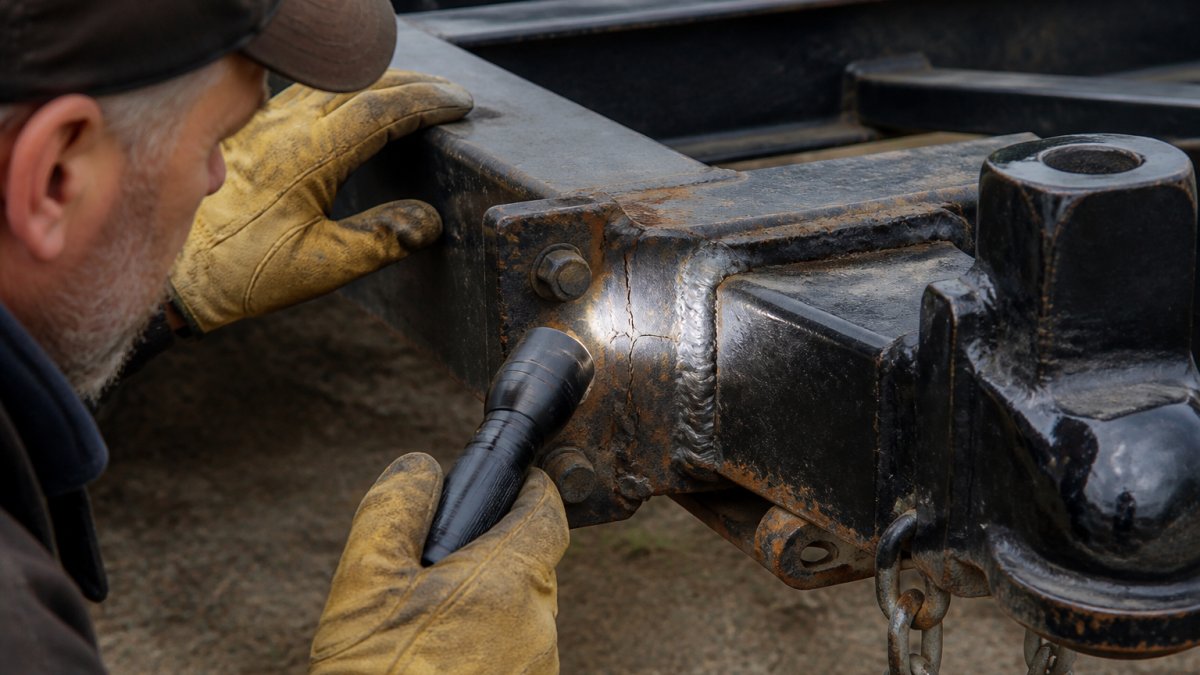
What to Check Before You Decide
Document what you find. Photograph each crack, note whether rust is surface-level or eating into the steel, and record the location of every defect. A common mistake is judging damage from the top deck alone. The underside tells the real story.
Localized Damage vs. Widespread Structural Deterioration
Localized damage is a single cracked weld or a bent crossmember on an otherwise sound frame. Widespread deterioration means rust, fatigue cracking, or bending across multiple sections. The first is a candidate for repair. The second usually points toward replacement. That distinction drives everything below.
Cracked Trailer Frame Repair: What Welding Can and Cannot Fix
Trailer welding repair works well on isolated defects in sound steel. It cannot rescue a frame that has lost its structural integrity through rust or repeated fatigue. A cracked trailer frame repair is only as good as the metal around it.
Welding a Cracked or Broken Trailer Frame
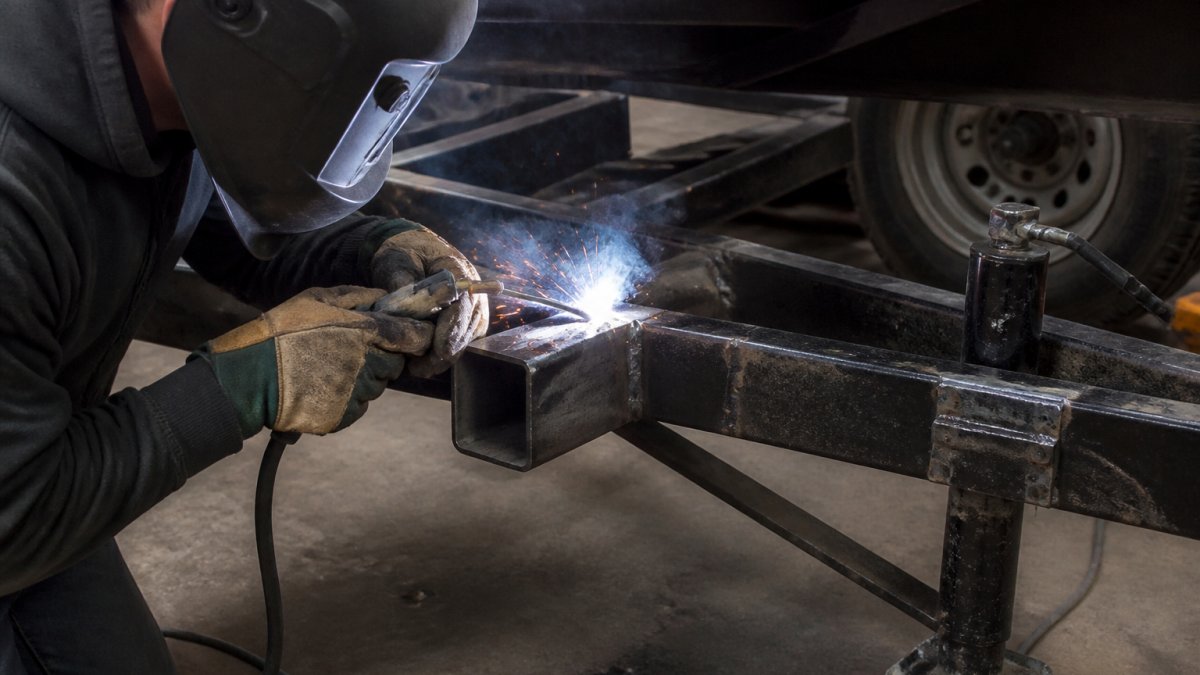
A proper weld repair follows a sequence. The technician grinds out the crack to its full depth, cuts out damaged material, and welds the joint back together. Weld quality depends on preparation and technique, not speed. Watch out: welding over rust or painting over a crack hides the problem and guarantees a repeat failure.
Replacing Damaged Frame Sections or Components
Sometimes the smarter fix is component replacement rather than welding. A bent axle hanger, a broken ramp, or a corroded frame section can be cut out and replaced with new replacement tubing. This restores the load-bearing structure without touching healthy steel.
Corrosion, Rust, and Fatigue Cracks That Cause Repeat Failures
Rust is the quiet killer of trailer frames. Corroded sections lose thickness, and thin steel cannot hold a weld. Fatigue cracking is the other repeat offender: a weld that failed once will fail again if the underlying cause, like flexing or overload, is never addressed.
The right finish prevents the cycle from restarting. Durable paint finishes for heavy duty trailers protect the frame from repeat deterioration. If rust keeps returning to the same spot, the frame is telling you something.
Trailer Welding Repair Cost: What Drives the Estimate
Trailer welding repair cost depends on damage extent, access, material, and downtime, so the most accurate figure comes from a direct quote. A single accessible weld crack costs far less than cutting out and replacing a frame section. Labor cost rises when the technician must strip components, work overhead, or handle aluminum, which needs different welding technique than steel. Because no two frames fail the same way, the only honest estimate comes from an inspection, but you can still build a realistic budget by understanding what drives the number.
Expect a repair estimate to factor in:
- Number and location of cracks. One crack on an open rail is a different job than three cracks tucked behind an axle hanger or above a crossmember.
- Whether damaged material must be cut out. Grinding out a crack and re-welding is cheaper than cutting out a section of rail and splicing in new tubing.
- Steel versus aluminum construction. Aluminum frames require different filler metal, cleaning, and technique, and many general shops will not touch them.
- Shop weld versus field weld. A shop with a lift and a positioner is faster and usually cheaper per hour than a mobile welder working on the ground in the weather.
A Repair-vs-Replacement Cost Worksheet
Before you approve any work, put these numbers side by side. You do not need exact figures to see which way the decision leans.
| Cost line | Repair | Replace |
|---|---|---|
| Parts and materials | Weld wire, filler, replacement tubing, coating | New frame or new trailer |
| Labor hours | Crack prep, weld, grind, finish | Teardown, transfer of components, setup |
| Downtime | Days out of service | Longer out of service |
| Trailer age and remaining service life | Limited by existing frame | Full service life |
| Repeat-failure risk | Higher on fatigued or corroded metal | Low on a new frame |
| Resale or trade value after work | Unchanged or slightly improved | Resets to new-trailer value |
If the repair estimate approaches a large share of replacement cost, and the trailer is already old or rusted, replacement usually wins on total cost of ownership, not just sticker price.
What Changes the Number Most
The single biggest cost swing is whether the damage is localized or structural. A localized crack in sound steel is a weld job. Widespread rust, multiple fatigue cracks, or a bent frame turns the same visit into a replacement conversation. The second biggest swing is material: aluminum repairs cost more per hour because fewer shops are equipped for them and the prep is less forgiving.
Trailer Frame Replacement Cost and When It Beats Repair
Trailer frame replacement cost runs higher than a weld repair, but it can be the cheaper choice over time. When a frame is rusted through in multiple places, bent beyond straightening, or has failed the same weld three times, repair becomes cost-prohibitive. Replacement cost also buys a fresh start on remaining service life.
| Factor | Repair | Replace |
|---|---|---|
| Best for | Localized damage, sound steel | Widespread rust, bent frame |
| Upfront cost | Lower | Higher |
| Downtime | Shorter | Longer |
| Remaining service life | Limited by existing frame | Full |
| Repeat failure risk | Higher on fatigued metal | Low |
Repair vs. Replacement: A Decision Framework
Use this framework to settle the question in a consistent order. Start with safety, then structural extent, then cost, then remaining service life.
Step 2, Is the damage localized or structural? Localized damage is a single cracked weld or a bent crossmember on an otherwise sound frame.
Step 3, Is the surrounding steel sound? A weld is only as good as the metal around it.
Step 5, Does the cost and downtime math favor replacement? Use the cost worksheet above.
Trailer-Specific Damage Scenarios
All weld repairs are not alike. Match the decision to the damage type:
- Frame cracks in sound steel. Repair. Grind out the crack, weld, and refinish. Verify the frame is square afterward.
- Rusted-through frame sections. Replace the section or the frame. Welding over rust hides the problem and guarantees a repeat failure.
- Broken ramps and hinges. Usually a component replacement rather than a frame decision. A bent ramp pin or broken hinge is a parts job, not a structural verdict.
- Suspension attachment points. Treat these as structural until proven otherwise. A cracked axle hanger or spring mount carries load and affects tracking; repair only if the surrounding steel is sound and the geometry can be restored.
- Aluminum structures. Repair is possible but shop-dependent. Fewer shops weld aluminum, prep is less forgiving, and a poor repair is harder to detect. Get a shop that works with aluminum regularly.
When to Bring in a Qualified Inspection
You can do the crawl-under inspection yourself, but some findings need a professional eye: cracks at suspension mounts, any damage near the coupler, a frame that will not measure square, or a repair that has already failed once. A qualified inspection is cheaper than a roadside failure, and it gives you a written basis for the repair-or-replace decision instead of a guess from the driver's seat.
Structural Safety, Roadworthiness, and Repair Verification
Structural integrity is not optional. A repaired frame must be verified before the trailer returns to the road. Ask for proof of weld quality, check that the frame is square, and confirm the repair holds under load. Federal safety standards for trailer lighting and equipment are set by NHTSA's vehicle safety standards, and a sound frame is the foundation everything else sits on.
Schedule a Trailer Repair Assessment at DoubleTake
A cracked weld is a warning, not a death sentence. The right call comes from a real inspection and a clear estimate, not a guess from the driver's seat. If you are weighing repair against replacement, our in-house service and parts department can assess the frame and tell you honestly which path makes sense. We also offer dump, utility, enclosed, and car hauler trailers, with custom builds and financing options available.
Frequently Asked Questions
Can a cracked trailer frame be safely welded?
A cracked trailer frame can be safely welded when the crack is localized, the surrounding steel is sound, and the repair follows proper welding technique. The damaged area should be cut out or grooved, the joint cleaned to bare metal, and the weld made with the correct process for the material, such as MIG or stick welding. A certified welder should confirm there is no fatigue cracking spreading beyond the visible crack. If rust has thinned the frame or the crack keeps returning, welding alone is not a safe fix.
Is it cheaper to weld a trailer frame or replace the trailer?
Welding is usually cheaper when damage is confined to one section and the rest of the frame is solid. A trailer welding repair cost depends on labor hours, weld accessibility, and whether the trailer is steel or aluminum, so get a written estimate that separates labor from materials. Compare that quote to the trailer frame replacement cost plus downtime. If the repair quote approaches the cost of a comparable used or new trailer, or the frame has widespread corrosion, replacement is often the better financial choice.
How do I know if my trailer frame needs to be replaced?
Replace the frame or trailer when damage is widespread rather than localized. Signs include rust that has thinned multiple frame sections, cracks that return after a previous weld, a bent frame that cannot be straightened within spec, and fatigue cracking near multiple weld joints. A frame inspection checklist should also flag sagging, cracked crossmembers, and welds that fail repeatedly. If the trailer age and remaining service life point to more repairs ahead, replacement avoids sinking money into a structure that is near the end of its life.
What should I check after a trailer frame has been welded?
After welding, inspect the repair for a continuous bead with no undercut, porosity, or cracks, and confirm the weld was made on clean bare metal. Check that the frame is straight and that the repaired section aligns with the rest of the load-bearing structure. Re-torque any fasteners that were removed, and test the trailer unloaded before hauling a full load. Ask the shop for the welding process used and keep the repair estimate and invoice, since repeat failure at the same joint usually means the original repair missed the root cause.